The Way of the River
A one-week retreat to explore the courageous potential of life
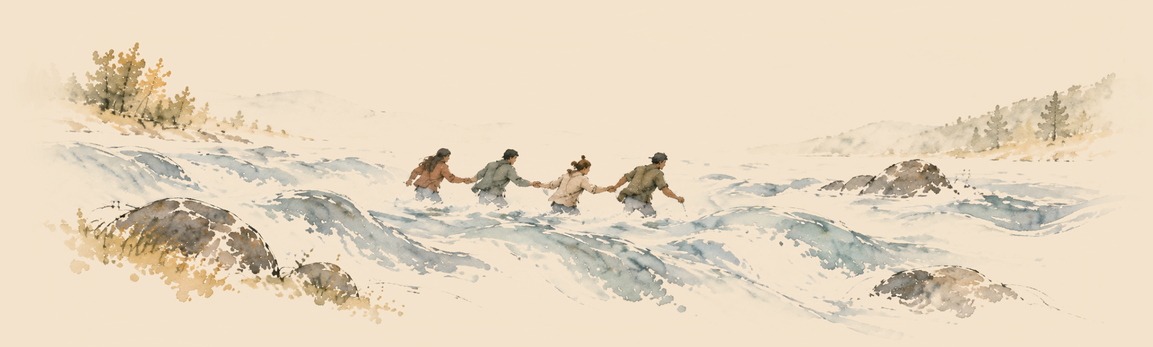
The Way of the River is a one-week residential journey through five relationships that can both liberate us and keep us stuck: our relationship with ourselves, another person, a community, the living world, and the mystery of life. We use conversation and silence, drawing and making, movement and reflection, time together and time alone, land and contemplation. The week offers activities and non-ordinary living conditions that help us listen for the life purpose that wants to emerge for us right now, and explore how these relationships can support or obstruct it.
The Sun–Moon rhythm: mind, body, and spirit
Every day is designed to engage mind, body, heart, and spirit around a particular theme of exploration. As the sun moves across the sky, so does the way we approach our enquiry.
Mornings are for the mind. In the fresh light of the day, we encounter new ideas and frameworks, ask one another questions, write, draw, and make connections and distinctions that help us understand the relationship we are exploring.
Afternoons are for the body and heart. As the day grows warmer, our enquiry moves into bodily and emotional experience. Through movement, shared tasks, relational exercises, land work, and other forms of embodied exploration, we investigate not only what we think, but what we feel and how we act.
Evenings are for the spirit. As the light falls, the rhythm of our togetherness changes. Dance, ritual, stories, fire, and symbolic practices can open different qualities of attention and invite non-ordinary states of awareness. Some evenings may include practices influenced by the shamanic tradition of the returning students at the Wild School.
This rhythm follows the movement of the day rather than a rigid timetable. There is space for rest, spontaneity, and whatever emerges from our encounters.
Explore the five days
Day 1 — Self
The first day invites us to explore the stories, choices, values, needs, and desires through which we understand ourselves.
We revisit our lives so far: their turning points, difficulties, joys, and choices. Through lifeline drawing and other reflective and creative practices, we explore what has shaped us and what we carry into the present.
We examine what we truly need and want, where our time and energy are going, and how the ways we satisfy our needs can bring us closer to our purpose—or become obstacles to it.
Day 2 — Another
On the second day, we turn our attention towards trust, listening, boundaries, control, care, and the small strategies we use in relationships.
Through paired encounters, listening practices, and embodied exploration, we uncover different ways of meeting another person: listening, influencing, manipulating, exercising power, or relinquishing control.
Together, we explore what happens when another person has needs, preferences, boundaries, and agency of their own—sometimes aligned with ours, sometimes in conflict with them.
Day 3 — Community
On the third day, we explore a group's generative potential: its capacity to create belonging, safety, and possibilities that none of its members could produce alone.
But we also examine the other side of collective life: conformity, invisible rules, struggles for power, and the ways belonging can sometimes require us to erase parts of ourselves.
Through collaborative challenges, creative work, theatre, and collective improvisation, we use our own group as a living field of enquiry. We observe how we interact, who takes space, who withdraws, how decisions emerge, and how these dynamics echo the other groups to which we belong—our families, friendships, communities, and workplaces.
Day 4 — World
The fourth day explores our relationship with what lies beyond our familiar world: people from different communities, non-human animals, plants, rocks, and the planet itself.
We step outside our habitual ways of looking and enter into attentive relationship with what surrounds us: the weather, the sound of the wind, the food the woods provide, the river, and the countless forms of life with which we share the Earth.
Through solitary time in nature, observation, and symbolic practices, we may begin conversations with stones, trees, and the land. We experiment with forms of divination and intuition, listening for the voice of Mother Earth.
Day 5 — Mystery
On the final day, we bring the week's encounters together and turn towards what remains mysterious in our lives: wonder, mortality, uncertainty, meaning, and spirit.
We explore sacred symbols and ceremonies of life, death, and renewal, including the collective creation of a spiral and the possibility of entering it through movement, dance, silence, or contemplation.
Some practices draw inspiration from shamanic traditions and invite us beyond our ordinary ways of understanding ourselves and the world.
The end of the day creates a safe passage towards returning home and integrating what we have learned: what have we encountered, what might we leave behind, and what do we wish to carry into our lives beyond the retreat?
Being together as method
Participation at the Wild School is unlike many other retreats. During this week, we offer our service to one another. Together, we prepare meals, do the washing up, make tea, light the fire, and sit quietly beside each other.
There is room not to participate all the time. Solitude, sleep, silence, unstructured time, privacy, and saying not now are part of the method. Joining the programme does not mean having to participate in every exercise or invitation. Watching, adapting, stepping out, or choosing another form of participation are all legitimate.
Practical information
See joining the River for dates, contributions and how to express your interest.
Format
The Way of the River is a one-week residential experience. Participants arrive on Sunday and leave the following Saturday. Five central days are devoted to exploring the five relationships.
Number of participants and languages
Usually 8–10 participants, working together in English, Italian, French, or Spanish, depending on the shared language of the group.
Examples of activities included
Social Presencing Theatre, shamanic journeys, structural family constellations, hands-on construction, forgiveness ceremonies, and blindfolded dances.
Dates
Click on Join to see the dates of the next Way of the River.