How can we bring together what is entangled and keep its differences meaningful?
The systems that bind contemporary globalised civilisation are so densely interdependent that disturbances in one part can cascade far beyond their point of origin.
Ecological, political, economic, social, psychological, and spiritual dimensions of global life form an interlocking web whose trajectories are causally entangled. Disturbances in one domain can amplify pressures elsewhere, force reciprocal accommodations, and reconfigure the conditions in which other disturbances develop. This mutually catalytic field of crises is often described as a global polycrisisMichael Lawrence et al. — “Global polycrisis: The causal mechanisms of crisis entanglement” (2024) · Judith J. Rakowski et al. — “Characterizing the Global Polycrisis: A systematic review of recent literature” (2025)Lawrence and colleagues define polycrisis through causal entanglement among crises across global systems, not simply their coexistence. Rakowski and colleagues' systematic review finds recurring emphasis on connected crisis trajectories and cascading or synergistic effects, while also warning that causal mechanisms are often under-specified.In conversation with ↓: Michael Lawrence et al. · Judith J. Rakowski et al. Source ↗ · Source ↗.
One of the clearest expressions of polycrisis is the convergence of pressures behind contemporary food crises. Extreme weather, rising energy and fertiliser costs, war, and trade restrictions have interacted across regions to reshape food production and prices. These pressures are mediated through economies in which markets do not, by themselves, reward food security; they reward returns. Production and distribution therefore tend towards demand backed by greater purchasing power, widening the distance between food availability and who can afford to purchase itAmartya Sen · availability and entitlements.Sen’s famine analysis distinguishes food being available from particular people actually being able to command it through income, employment, production, exchange, ownership or transfers. This supports the availability/access distinction, not the separate claim about what markets reward.In conversation with ↓: Amartya Sen Amartya Sen ↗. The consequences extend through household security, physical and mental health, migration, and political stability.
In 1982, Agnes Denes planted and harvested two acres of wheat on the Battery Park landfill in lower Manhattan, a few blocks from Wall Street and the World Trade Center. Over four months, the rubble-strewn site was cleared, planted, irrigated, weeded, and tended until it produced more than a thousand pounds of wheat. The harvested grain later travelled to twenty-eight cities in The International Art Show for the End of World Hunger, while seeds were taken away and planted elsewhere.
One of the perversities of polycrisis is that responsibility and vulnerability often run in opposite directionsClimate responsibility and vulnerability.Chancel documents large inequalities in greenhouse-gas emissions across income and wealth groups. The IPCC finds that communities which have historically contributed least to current climate change are disproportionately affected, with vulnerability shaped by inequalities in resources, institutions, exposure and adaptive capacity. Together these sources support a climate-specific responsibility–vulnerability asymmetry; they do not establish a universal inverse ranking across every ecological harm.In conversation with ↓: Lucas Chancel · IPCC AR6 Lucas Chancel ↗ · IPCC AR6 ↗: those who contribute most to ecological disruption are often among the least likely to experience its adverse consequences.
These asymmetries have histories and ancestorsKanchana N. Ruwanpura, Gustav Cederlöf & Vasna Ramasar — “Decolonising polycrisis: Southern perspectives on interlocking crises” (2025)Ruwanpura, Cederlöf and Ramasar challenge accounts in which overlapping crisis appears newly exceptional by foregrounding longer global-South histories of ecological shocks, debt, dependency, colonial extraction and uneven development. Histories and ancestors is Wild School wording shaped by that historical correction, not their phrase.In conversation with ↓: Kanchana N. Ruwanpura, Gustav Cederlöf & Vasna Ramasar Source ↗. Colonial extraction, debt, land dispossession, conditional aid, and asymmetric trade have left many low-income countries carrying vulnerabilities accumulated over centuries. Some outlived the arrangements that produced them; others were deepened by newer forms of dependency and extraction. For many of their populations, ecological, economic, and political shocks arriving together are not a newly discovered condition of the twenty-first century.
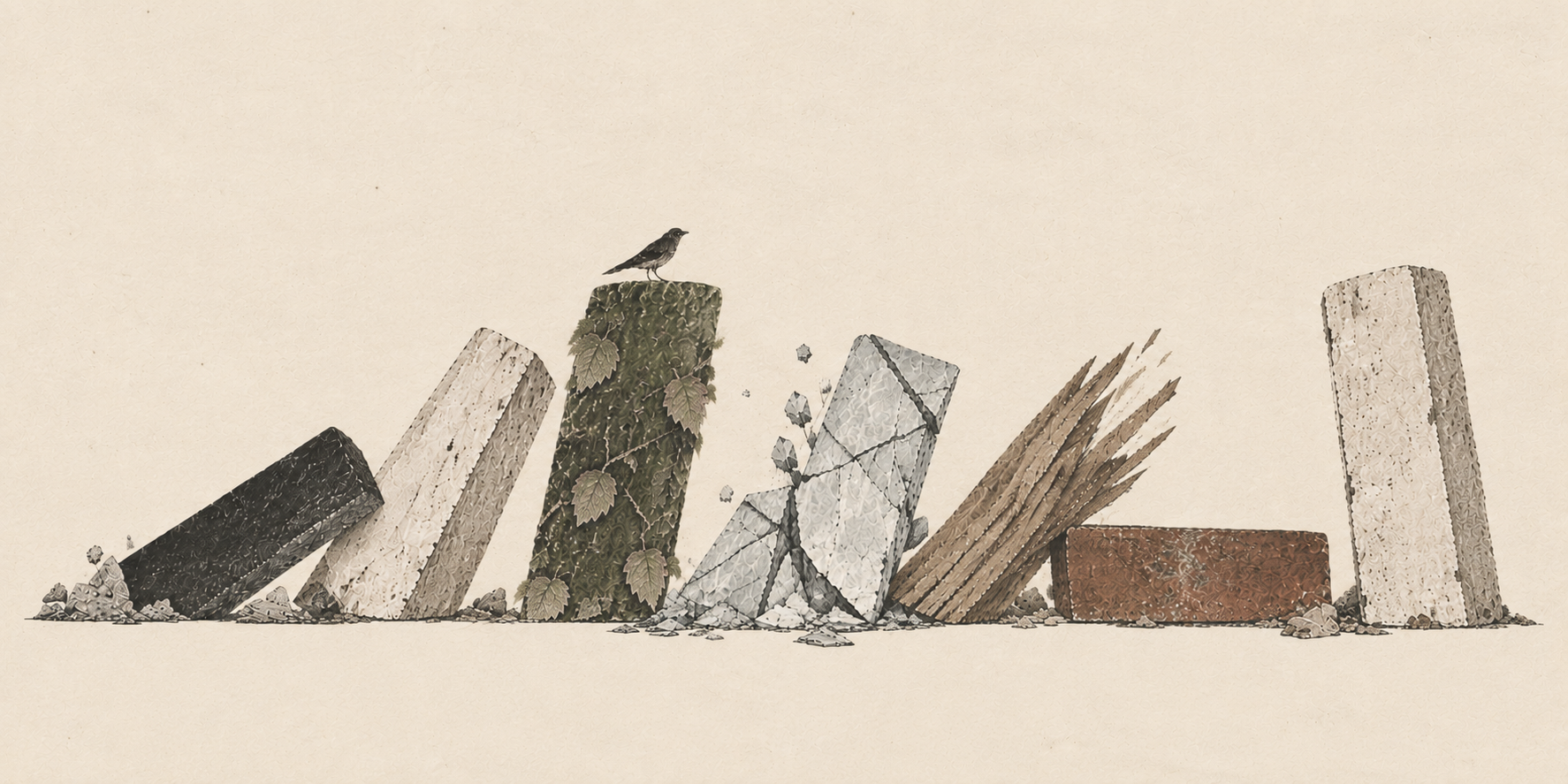
The institutions through which these crises are studied and governed inherit a long Western habit of dividing complex realities into smaller domains of inquiry, with deep roots in Aristotelian classificationAristotle — Metaphysics, Book VI.1Aristotle distinguishes practical, productive and theoretical forms of knowledge and assigns different sciences distinct domains of inquiry. This is a genealogy of differentiated inquiry, not a claim that Aristotle caused modern disciplinary silos.In conversation with ↓: Aristotle Source ↗ and Cartesian decompositionRené Descartes — Discourse on the Method, Part II (1637)Descartes's method includes dividing difficult problems into as many parts as needed, then proceeding from simpler matters toward more complex ones. Decomposition is one part of a wider analytic method; it is not presented here as the sole origin of modern fragmentation.In conversation with ↓: René Descartes Source ↗. These habits have generated extraordinary technical knowledge, but they have also helped build a Western wall of knowledgePeople's Knowledge Editorial Collective (Ed.) — People's Knowledge and Participatory Action Research: Escaping the White-Walled Labyrinth (2016)The phrase deliberately echoes this collection's critique of the institutional boundaries through which professionally credentialed knowledge can be separated from lived and community-produced knowledge. The allusion concerns authority and knowledge-making; it is not a claim that all Western knowledge is uniformly fragmented.In conversation with ↓: People’s Knowledge Editorial Collective Source ↗ in which research, action, and policy are separated into specialised bricks.
What institutions separate, a life integrates. Job insecurity can mean unstable income, bodily exhaustion, sleeplessness, conflict at home, status anxiety, and a crisis of meaning. All these effects are studied separately, but they are lived and suffered at once.
The Wild School is an experiment in resisting that dispossession of experience. We work to create a place in which care for food, the body, relationships, ecology, and spiritual life can nourish one another. As we do so, we remain curious about what meanings emerge for a human life when these forms of care are lived together.
In conversation with
Active empirical and conceptual foundations
Bishoy L. Zaki — polycrisis typologyReadClose
Zaki, B. L. (2025). Beyond the Buzzword: Rethinking polycrises in public policy and administration research. Risk, Hazards & Crisis in Public Policy, 16(2), e70015. DOI: 10.1002/rhc3.70015 ↗
Zaki argues that “polycrisis” is often used too loosely in public-policy and administration research, sometimes collapsing different kinds of crisis interaction into a single static label. He calls for conceptual disaggregation and research designs that distinguish how separate crises are actually related. His typology differentiates tightly coupled, loosely coupled, cascading-effect and time-congruent polycrises, allowing cases that may look equally “polycrisis-like” at the surface to be analysed through different structures of interaction.
Christian Dorninger et al. — ecologically unequal exchangeReadClose
Dorninger, C., Hornborg, A., Abson, D. J., von Wehrden, H., Schaffartzik, A., Giljum, S., Engler, J.-O., Feller, R. L., Hubacek, K., & Wieland, H. (2021). Global patterns of ecologically unequal exchange: Implications for sustainability in the 21st century. Ecological Economics, 179, 106824. DOI: 10.1016/j.ecolecon.2020.106824 ↗
Dorninger and colleagues test the theory of ecologically unequal exchange using environmentally extended multi-regional input-output data for 170 countries between 1990 and 2015. They trace materials, energy, land and labour embodied in international trade and compare these biophysical flows with monetary value added. The study finds a persistent pattern in which high-income countries are net appropriators of embodied materials, energy and labour while lower-income countries are disproportionately net providers, although patterns differ by resource and country group. Monetary returns are also unequal: high-income economies obtain substantially more value added per unit of embodied material or labour. The authors describe the results as evidence consistent with ecologically unequal exchange rather than definitive proof of every proposed mechanism.
Judith J. Rakowski et al. — polycrisisReadClose
Rakowski, J. J., Schaan, L. N., van Klink, R., Herzon, I., Arth, A., Hagedorn, G., Rode, J., Creutzig, F., & Pe’er, G. (2025). Characterizing the Global Polycrisis: A systematic review of recent literature. Annual Review of Environment and Resources, 50, 159–183. DOI: 10.1146/annurev-environ-111523-102238 ↗
Rakowski and colleagues review the developing polycrisis literature in two stages, screening 2,299 publications and analysing 59 in depth. Across the literature they find recurring features in definitions of polycrisis: multiple crises occur together, their trajectories are causally connected, and their interactions can produce cascading or synergistic effects. At the same time, they find substantial variation in what counts as a crisis, which underlying drivers are proposed, and how links among crises are specified. A central conclusion is that the literature is much stronger at naming constellations of crisis than at demonstrating the mechanisms linking them: causal maps, models and empirical tests remain comparatively scarce, and many proposed intervention pathways are still underdeveloped.
Amartya Sen — food availability / entitlements and accessReadClose
Sen, Amartya. 1981. “Ingredients of Famine Analysis: Availability and Entitlements.” The Quarterly Journal of Economics 96(3): 433–464. Source ↗
Sen argues that famine cannot be understood through aggregate food availability alone. His entitlement approach asks what food people are actually able to command through production, employment income, exchange, ownership and transfers. A population can therefore face starvation even when total food availability has not collapsed if particular groups lose the means to acquire food. The analysis shows why food being present in a system and people being able to obtain it are different questions.
Kanchana N. Ruwanpura, Gustav Cederlöf & Vasna Ramasar — historical asymmetry of crisisReadClose
Ruwanpura, K. N., Cederlöf, G., & Ramasar, V. (2025). Decolonising polycrisis: Southern perspectives on interlocking crises. Environment and Planning A: Economy and Space, 57(6), 697–703. DOI: 10.1177/0308518X251345308 ↗
Ruwanpura, Cederlöf and Ramasar argue that contemporary polycrisis discussion often begins from a Euro-American experience in which overlapping crises appear newly exceptional. They begin instead from global South histories in which ecological shocks, debt, unequal development and political-economic dependency have long interacted. Pakistan’s 2022 floods and debt burden provide an opening example: climate-related destruction increased fiscal pressure while debt constrained the resources available for recovery and climate response. The authors place such interactions within longer histories of colonial extraction, uneven development, unequal exchange and global governance, while also insisting that proposed causal connections should be empirically tested rather than assumed.
Katherine Richardson et al. — planetary boundariesReadClose
Richardson, K., Steffen, W., Lucht, W., et al. (2023). Earth beyond six of nine planetary boundaries. Science Advances, 9(37), eadh2458. DOI: 10.1126/sciadv.adh2458 ↗
Richardson and colleagues update the planetary-boundaries framework by quantifying all nine proposed boundaries and conclude that six are transgressed. The framework treats the boundaries as interdependent components of the Earth system rather than as separate environmental problems, using a Holocene-like state as the reference for a precautionary “safe operating space.” The paper introduces human appropriation of net primary production as a control variable for functional biosphere integrity, finds that boundary transgressed, and uses climate and land-system modelling to illustrate how pressure on one boundary can alter risks associated with another. The authors present boundary transgression as an increase in systemic risk rather than as a claim that every boundary is itself a discrete tipping point.
Chancel reconstructs the distribution of greenhouse-gas emissions across global income and wealth groups from 1990 to 2019, combining distributional data with environmental input-output information and country-level estimates. The analysis attributes emissions not only to household consumption but also to private investment and government expenditure, and includes emissions embodied in international trade. For 2019, it estimates that the bottom half of the global population was responsible for roughly 12% of emissions while the top 10% accounted for about 48%. The study also finds that carbon inequality increasingly exists within countries rather than simply between rich and poor countries, and that investment accounts for a particularly large share of the footprint of the highest emitters.
IPCC. 2023. “Summary for Policymakers.” In Climate Change 2023: Synthesis Report. Contribution of Working Groups I, II and III to the Sixth Assessment Report of the Intergovernmental Panel on Climate Change, Core Writing Team, H. Lee and J. Romero (eds.). Geneva: Intergovernmental Panel on Climate Change, pp. 1–34. Source ↗
The AR6 Synthesis Report finds with high confidence that vulnerable communities which have historically contributed least to current climate change are disproportionately affected. The underlying WGII assessment shows that vulnerability differs substantially within and among regions and is shaped by socioeconomic development, inequity, marginalisation, historical and ongoing inequalities, governance, access to services and resources, conflict and climate-sensitive livelihoods. This evidence concerns climate change and does not establish a universal inverse ranking between responsibility and vulnerability across every ecological impact.
Michael Lawrence et al. — causal entanglementReadClose
Lawrence, M., Homer-Dixon, T., Janzwood, S., Rockström, J., Renn, O., & Donges, J. F. (2024). Global polycrisis: The causal mechanisms of crisis entanglement. Global Sustainability, 7, e6. DOI: 10.1017/sus.2024.1 ↗
Lawrence and colleagues define global polycrisis not as the simultaneous occurrence of many crises but as the causal entanglement of crises in multiple global systems. They distinguish relatively fast crisis triggers from slower stresses that increase systemic vulnerability, and describe several ways crises can become connected: the same stress can affect more than one system; disruption in one system can propagate into another through domino effects; and systems can enter feedback relationships that amplify or synchronise disturbances. The paper also resists a loose “everything is connected” interpretation, arguing that polycrisis research must identify the pathways through which one crisis changes the trajectory or severity of another if the concept is to have explanatory value.
Genealogies of separation
Aristotle — classification of knowledgeReadClose
Aristotle. Metaphysics, Book VI, Chapter 1 (1025b3–1026a32), trans. W. D. Ross. In W. D. Ross (Ed.), Aristotle’s Metaphysics, Vol. I. Oxford: Clarendon Press, 1924. Source ↗
In Metaphysics VI.1 Aristotle distinguishes practical, productive and theoretical forms of knowledge and describes particular sciences as delimiting specific classes of beings or domains of inquiry. Within theoretical knowledge he differentiates natural science and mathematics, while assigning “first philosophy” the study of being as being and of what belongs to being in itself. The passage therefore presents a differentiated organisation of inquiry in which distinct sciences investigate distinct kinds or aspects of what exists.
People’s Knowledge Editorial Collective — knowledge and powerReadClose
People’s Knowledge Editorial Collective (Ed.). (2016). People’s Knowledge and Participatory Action Research: Escaping the White-Walled Labyrinth. Rugby, UK: Practical Action Publishing. ISBN 9781853399329 (paperback); 9781780449395 (eBook/PDF). Source ↗
This edited collection examines the relationship between knowledge and power, especially the unequal authority accorded to professionally credentialed research and to knowledge produced through lived experience. Its contributors describe how academic language, institutional funding, professional incentives, ownership of analysis and expectations about legitimate research can reproduce inequalities even in projects described as participatory. Case chapters examine community-led and collaborative research, tokenism, recognition, mutual learning and the political economy of professional expertise. The concluding “signposts” ask who produces knowledge, whom it serves and alongside or against whom it is made, and argue that ethical and participatory practice cannot be reduced to institutional procedures or specialist methodologies.
René Descartes — decomposition as methodReadClose
Descartes, R. (1637). Discourse on the Method, Part II. English trans. John Veitch, A Discourse on Method. Project Gutenberg eBook No. 59. Source ↗
In Part II of the Discourse on Method, Descartes sets out four rules for conducting inquiry. He proposes accepting only what can be known clearly, dividing each difficulty into as many parts as necessary for its solution, directing thought in an ordered movement from simpler matters toward more complex ones, and making sufficiently complete enumerations and reviews to avoid omissions. Division is therefore one element in a wider method intended to make reasoning orderly and reliable.
Artistic and literary influences
Agnes Denes — conflicting values of landReadClose
Denes, A. (1982). Wheatfield—A Confrontation [site-specific environmental artwork], Battery Park City Landfill, New York, May–September 1982. Commissioned by Public Art Fund. Source ↗
In 1982 Agnes Denes planted and harvested a field of wheat on landfill at Battery Park City in lower Manhattan, near Wall Street and the World Trade Center. Creating the work required clearing urban debris, digging and sowing furrows, irrigating and maintaining the field for several months, and finally harvesting the crop. Denes’s own account places the wheat deliberately against the exceptional real-estate and financial value of the site and names food, energy, commerce, world trade, economics, waste, world hunger and ecological concern among the work’s subjects. After harvest, the grain travelled in an international exhibition concerned with world hunger, and seeds from the crop were distributed and planted elsewhere.
Octavia E. Butler — compounded crisis as lived experienceReadClose
Butler, O. E. (1993). Parable of the Sower. New York: Four Walls Eight Windows. Source ↗
Set in a near-future California destabilised by climate change, severe inequality, failing public systems and pervasive violence, Parable of the Sower follows Lauren Olamina, a young Black woman living in a walled neighbourhood whose apparent security is increasingly fragile. After the community is destroyed, Lauren travels north with other survivors through a landscape shaped by fire, water scarcity, displacement, exploitation and danger. During the journey she develops and records Earthseed, a system of belief centred on change, while the travelling group grows into a provisional community seeking a place where they can live together.