Many of us are acculturated, educated, and professionally rewarded into a particular worldview of success. Its protagonist is an individual advancing through levels. As one progresses, one becomes more qualified, productive, prosperous, influential, or powerful. Western-influenced systems of formal education reinforce this worldview, organising educational development as an individual progression through successive levels of readiness for entry into a world of opportunity waiting to be seized for one's benefit and security.
← I — Entangled crises in a fragmented world
II
Contents
- I — Entangled crises in a fragmented world
- II — The displaced costs of success
- III — The manufacture of not-enough
- IV — A system of invisible walls
- V — Liberation activism is a path
- VI — The interdependences of wellbeing
- VII — Creating relational abundance
- VIII — Becoming intimate with the wild
- IX — The Wild School as a wager
The displaced costs of success
How can we act with purpose and hold close the costs of our actions?
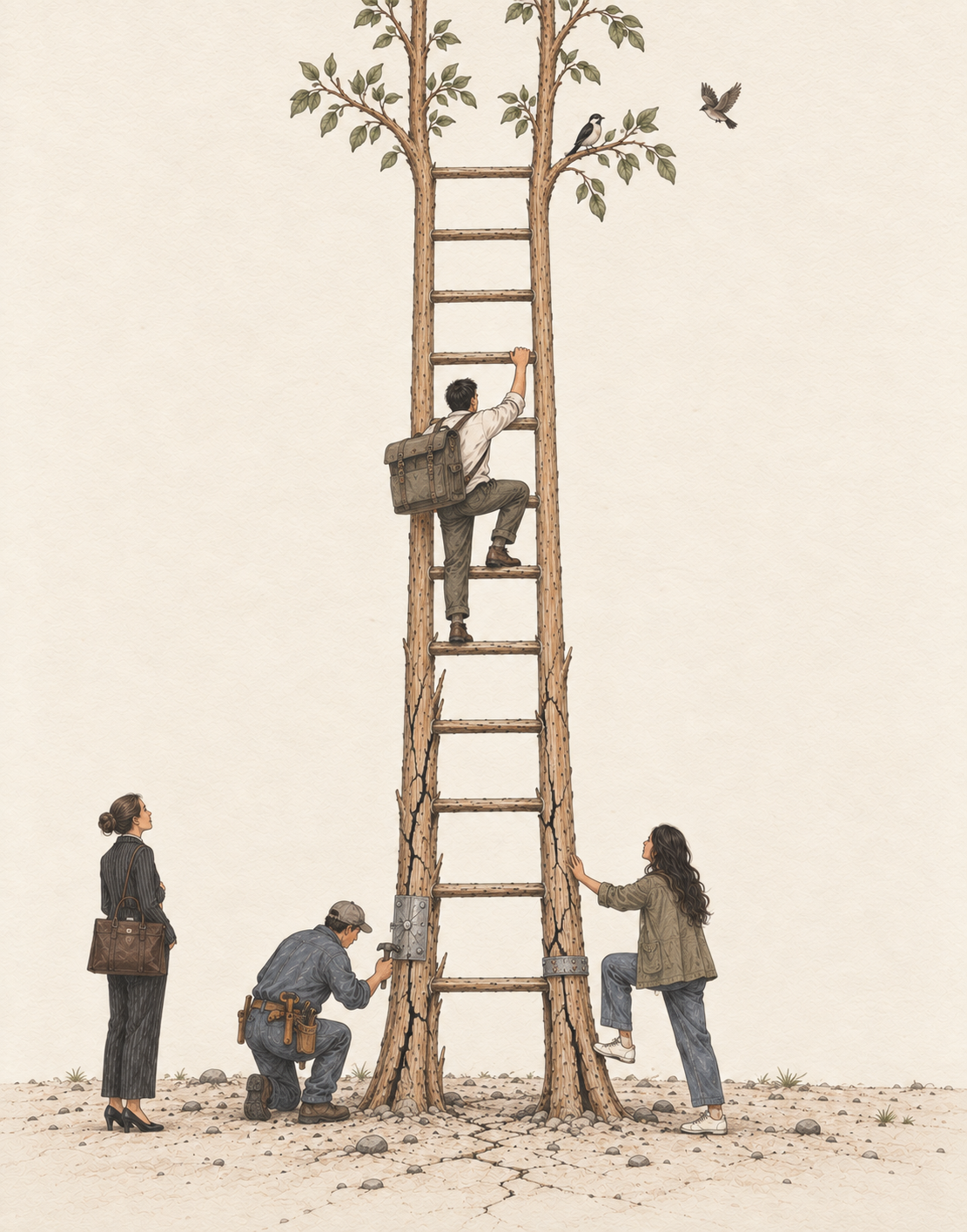
This worldview also shapes institutions, whose grammar of success privileges growth, profitability, reach, and efficiency. At its centre stands a hierarchy of more or less successful protagonists. The human individual in them faces a world outside the self that is to be organised around, and made available to, that individual’s growth: land as raw material, time as a resource to be optimised, other people as labour inputs, and living systems as reservoirs from which matter and energy may be drawn.
What actually sustains human life recedes into the scenery of this performance of success, whose rewards are imagined as something to be earned through hard work. Land, water, sunlight, air, and life itself are present before the performance begins. Precisely because they are not earned, their availability can come to feel like entitlement: what is not earned is reduced to input. What the planet offers is received instead as material for advancement, consumption, and, eventually, disposal.
The deterioration and extraction of life itself is not, or not exclusively, a moral problem of greed, ignorance, or voracity. Alone, these are inadequate explanatory categories for a general theory of collective failure. Human beings act as constrained agents within institutions and environments they did not choose, adapting to rules, incentives, norms, and material conditions that may reward extraction even when no individual intends the cumulative result. In systems organised around extraction, participation can also depend on distance from the suffering and depletion through which ordinary life is sustained. We have adapted, often without full sight of the consequences accumulating beyond the scale of our actions, to a global political, economic, and social order that is violent, unsafe, complex, uncertain, and changing.
Inner moral (r)evolutions can cultivate the courage to refuse, withdraw from, or organise against an extractive order. But the relation between individual action and destructive collective outcomes is also institutional: political, economic, and social rules and norms translate a hegemonic cultural worldview of successAntonio Gramsci — Selections from the Prison Notebooks (1971 English edition)Gramsci's accounts of hegemony and common sense describe social rule as operating partly through consent and historically formed everyday assumptions, not coercion alone. Hegemonic cultural worldview of success is Wild School synthesis using this conceptual genealogy, not a Gramsci quotation.In conversation with ↓: Antonio Gramsci
Source ↗ into real incentives and constraints, shaping which actions are rewarded, which consequences remain visible, and where their costs are borne.
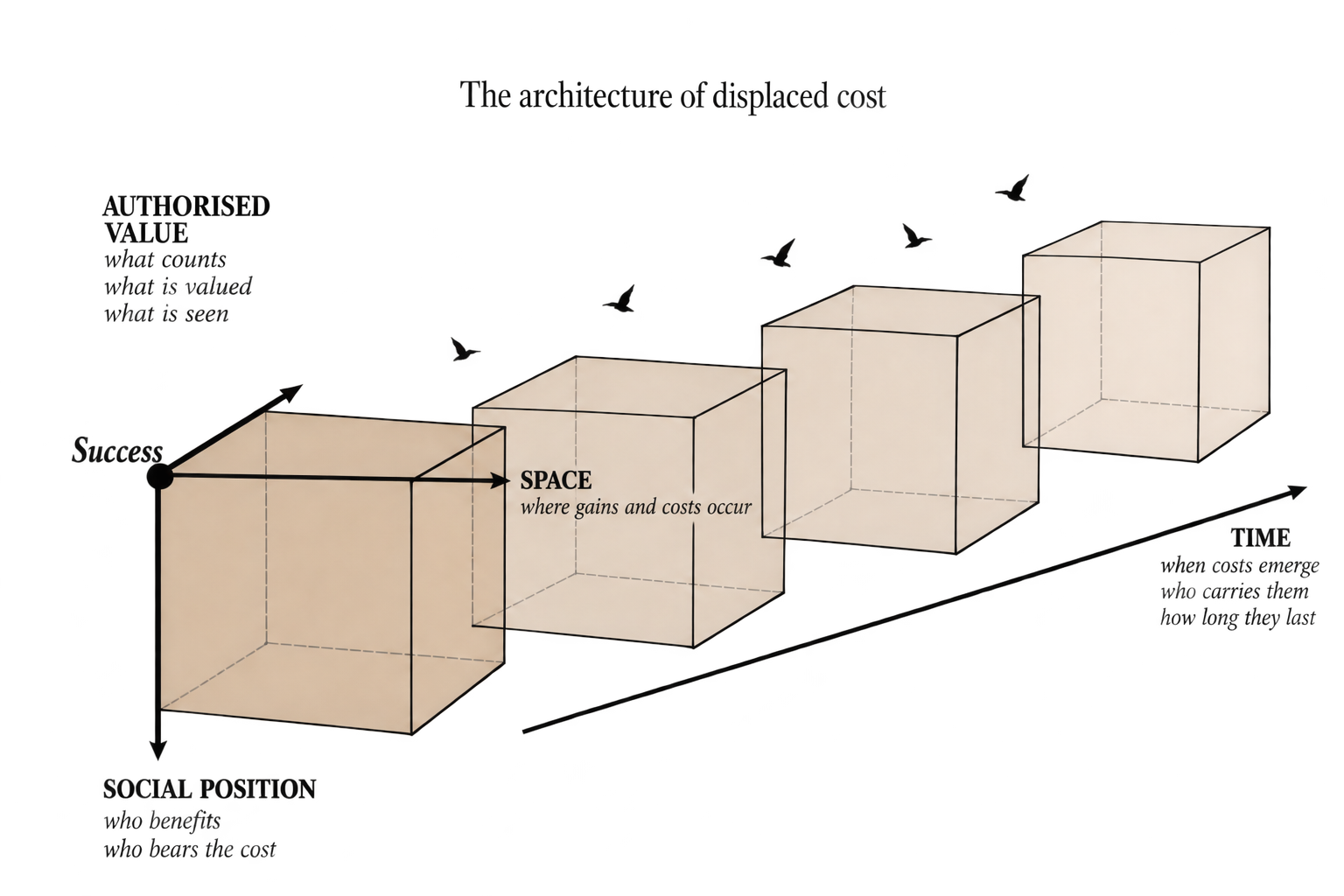
The architecture of displaced cost
The rules of national and global institutions, together with the norms of the people who compose them, enable and arrange the displacement of the costs generated in the pursuit of this model of success.
Space
The first dimension is space. Extractive success depends upon labour, land use, pollution, and ecological depletion occurring elsewhere. Contemporary capitalist production is structured through forms of ecologically unequal exchangeChristian Dorninger et al. — “Global patterns of ecologically unequal exchange: Implications for sustainability in the 21st century” (2021)Dorninger and colleagues trace materials, energy, land and labour embodied in international trade and find persistent asymmetries between high-income net appropriators and lower-income net providers. The concept identifies unequal biophysical and monetary exchange patterns; it does not provide one universal explanation for every country's development history.In conversation with ↓: Christian Dorninger et al.
Source ↗: gains concentrated in one place can be sustained by material and ecological burdens borne in another. These inequalities are not accidental. They travel along routes already carved by colonial extraction, debt relationships, and unequal participation in global governance.
Social position / power
The second dimension is social position. The rewards and burdens of the existing economic order are unjustly distributed not only across societies but within them. Wealth, ownership, investment, income, and class shape a socioeconomic maldistributionNancy Fraser — “Social Justice in the Age of Identity Politics: Redistribution, Recognition, and Participation” (1998)Fraser uses maldistribution for economic arrangements that deprive people of resources needed to participate as peers. Her wider account treats redistribution and recognition as distinct but interacting dimensions of injustice.In conversation with ↓: Nancy Fraser
Source ↗ in which some actors are better positioned to capture the gains generated by economic activity, while others carry more of its ecological and social burdens, often without owning or controlling the activities that produce them.
Authorised value
The third dimension is authorised value. Costs can remain materially present, even visible, while being culturally pushed into an “excluded sphere”Val Plumwood — “Nature, Self, and Gender: Feminism, Environmental Philosophy, and the Critique of Rationalism” (1991)Plumwood describes an excluded sphere whose members, activities and dependencies are backgrounded and treated instrumentally by a privileged sphere. Her critique preserves the distinctness of what has been subordinated rather than dissolving difference into merger.In conversation with ↓: Val Plumwood
Source ↗, where their burden is normalised, discounted, or justified as a necessary sacrifice for the theatre of success. Outsourced and devalued care, the uneven distribution of maintenance, ecological disintegration, bodily exhaustion, and mental suffering may be indispensable to the production of success even as they remain secondary to the values through which success itself is judged.
Those who innovate and develop are given praise, but, as Mierle Laderman Ukeles asks, “after the revolution, who’s going to pick up the garbage on Monday morning?”Mierle Laderman Ukeles — Manifesto for Maintenance Art 1969! Proposal for an exhibition “CARE” (1969)Ukeles contrasts development — novelty, change and progress — with maintenance: the repeated work of keeping, cleaning, repairing, renewing and sustaining. Her manifesto makes the labour that keeps life and institutions functioning visible as art.In conversation with ↓: Mierle Laderman Ukeles
Source ↗ Narratives of radical success and progress depend upon forms of maintenance they often treat as valueless.
 Photo · Marian Wood Kolisch / Oregon State University · Wikimedia CommonsCC BY-SA 2.0 · open source / licence ↗
Ursula K. Le Guin, August 1995 · Photo by Marian Wood Kolisch / Oregon State University · CC BY-SA 2.0 · Wikimedia Commons ↗
Companion work
Ursula K. Le Guin — The Ones Who Walk Away from Omelas
Omelas is a beautiful, prosperous city whose happiness depends upon the suffering of a single child kept in misery. Its citizens are eventually shown the child and told that the city’s flourishing depends upon its condition. Most return to their lives. A few leave Omelas and walk away towards an unknown destination.
Time
The fourth dimension is time. The horizon of success is much shorter than the processes through which its costs emerge. Corporate quarters, electoral cycles, and individual careers unfold against ecological processes marked by lag, path dependence, and lock-in. A decision can therefore appear successful within the period in which it is rewarded while narrowing the conditions available to future lifeHans Jonas — The Imperative of Responsibility: In Search of an Ethics for the Technological Age (1984 English edition)Jonas argues that technological power extends the consequences of action across time and scale, requiring responsibility toward the conditions of future human life and the biosphere on which it depends. The argument is normative, not an empirical prediction of particular future harms.In conversation with ↓: Hans Jonas
Source ↗. Such disregard for the future becomes possible when consequences travel farther than responsibilityWild School synthesis · in conversation with Hans Jonas — The Imperative of Responsibility (1984 English edition)The sentence is Wild School wording. Jonas supplies a central floorboard: modern action can have cumulative, distant and long-term consequences that exceed the proximate ethical frame through which responsibility has traditionally been understood.In conversation with ↓: Hans Jonas
Source ↗: the effects of action now extend beyond the lives and institutions that produce them, while the structures that assign responsibility remain bounded by much shorter horizons. In the theatre of success, actors borrow from the future.
These displacements do more than distribute the costs of success; they can also make us myopic in learning from it. The theatre of success teaches from a partial record. Without wisdom, our actions become excessively fit for purpose: ever better at achieving the objective immediately before us, while becoming less able to learn from what that achievement pushes beyond view.
Evolutionary fitness offers no promise of persistenceKalle Parvinen — “Evolutionary suicide” (2005)Parvinen reviews evolutionary models in which natural selection moves a viable population toward traits that eventually make persistence impossible. The concept shows that local adaptive success need not guarantee long-term population survival; it is not a general analogy proving that human institutions behave like evolving populations.In conversation with ↓: Kalle Parvinen
Source ↗: adaptation can become self-undermining. The literature on “evolutionary suicide” describes the striking possibility of a viable population adapting in ways that eventually make its own persistence impossible. Human beings now inhabit an analogous paradox at planetary scale. Capacities that enlarged our ability to survive and reproduce are now being used to destabilise some of the ecological conditions through which human life became possible.
The Wild School is an exploration of what changes when the ecological and relational conditions that sustain us are encountered as gifts that place us in relationshipWild School synthesis · in conversation with Robin Wall Kimmerer — The Serviceberry: Abundance and Reciprocity in the Natural World (2024)Kimmerer's Citizen Potawatomi-grounded account treats what sustains life as gift within relations of gratitude, reciprocity and responsibility rather than ownership alone. Gifts that place us in relationship is Wild School wording, not a quotation from Kimmerer.In conversation with ↓: Robin Wall Kimmerer
Source ↗. Receiving a gift creates responsibilities of care, reciprocityRobin Wall Kimmerer — The Serviceberry: Abundance and Reciprocity in the Natural World (2024)Kimmerer presents reciprocity as part of an ongoing relation among receiving, gratitude, restraint and responsibility. The chapter uses this genealogy without implying that gifts are obligationless, automatically egalitarian or reducible to equivalent repayment.In conversation with ↓: Robin Wall Kimmerer
Source ↗ and restraint that can extend beyond ourselves and beyond the present. At the School, we want to remain attentive to the costs displaced by our own forms of success: what our growth, efficiency, intensity, cohesion or financial security might ask of other people, the land, and those who come after us.
In conversation with
Power, distribution and displaced cost
Antonio Gramsci — hegemony and common senseReadClose
Gramsci, A. (1971). Selections from the prison notebooks of Antonio Gramsci (Q. Hoare & G. Nowell Smith, Eds. & Trans.). International Publishers. Source ↗
In the Prison Notebooks, Gramsci describes social rule as operating through both coercion and hegemony: a dominant group can secure “spontaneous” consent through institutions, intellectual activity and social relations that give its direction prestige and authority. He also treats ordinary people as participants in conceptions of the world rather than as non-intellectuals. His discussions of “common sense” describe everyday consciousness as historically formed, heterogeneous and often contradictory: assumptions inherited from social life can reproduce an existing order, while experience can also contain elements capable of being made more coherent and critical.
Christian Dorninger et al. — ecologically unequal exchangeReadClose
Dorninger, C., Hornborg, A., Abson, D. J., von Wehrden, H., Schaffartzik, A., Giljum, S., Engler, J.-O., Feller, R. L., Hubacek, K., & Wieland, H. (2021). Global patterns of ecologically unequal exchange: Implications for sustainability in the 21st century. Ecological Economics, 179, 106824. DOI: 10.1016/j.ecolecon.2020.106824 ↗
Dorninger and colleagues test the theory of ecologically unequal exchange using environmentally extended multi-regional input-output data for 170 countries between 1990 and 2015. They trace materials, energy, land and labour embodied in international trade and compare these biophysical flows with monetary value added. The study finds a persistent pattern in which high-income countries are net appropriators of embodied materials, energy and labour while lower-income countries are disproportionately net providers, although patterns differ by resource and country group. Monetary returns are also unequal: high-income economies obtain substantially more value added per unit of embodied material or labour. The authors describe the results as evidence consistent with ecologically unequal exchange rather than definitive proof of every proposed mechanism.
Kanchana N. Ruwanpura, Gustav Cederlöf & Vasna Ramasar — colonial histories of unequal burdenReadClose
Ruwanpura, K. N., Cederlöf, G., & Ramasar, V. (2025). Decolonising polycrisis: Southern perspectives on interlocking crises. Environment and Planning A: Economy and Space, 57(6), 697–703. DOI: 10.1177/0308518X251345308 ↗
Ruwanpura, Cederlöf and Ramasar argue that contemporary polycrisis discussion often begins from a Euro-American experience in which overlapping crises appear newly exceptional. They begin instead from global South histories in which ecological shocks, debt, unequal development and political-economic dependency have long interacted. Pakistan’s 2022 floods and debt burden provide an opening example: climate-related destruction increased fiscal pressure while debt constrained the resources available for recovery and climate response. The authors place such interactions within longer histories of colonial extraction, uneven development, unequal exchange and global governance, while also insisting that proposed causal connections should be empirically tested rather than assumed.
Lucas Chancel — carbon inequalityReadClose
Chancel, L. (2022). Global carbon inequality over 1990–2019. Nature Sustainability, 5, 931–938. DOI: 10.1038/s41893-022-00955-z ↗
Chancel reconstructs the distribution of greenhouse-gas emissions across global income and wealth groups from 1990 to 2019, combining distributional data with environmental input-output information and country-level estimates. The analysis attributes emissions not only to household consumption but also to private investment and government expenditure, and includes emissions embodied in international trade. For 2019, it estimates that the bottom half of the global population was responsible for roughly 12% of emissions while the top 10% accounted for about 48%. The study also finds that carbon inequality increasingly exists within countries rather than simply between rich and poor countries, and that investment accounts for a particularly large share of the footprint of the highest emitters.
Mierle Laderman Ukeles — development / maintenanceReadClose
Ukeles, M. L. (1969). Manifesto for Maintenance Art 1969! Proposal for an exhibition “CARE” [Manifesto]. Source ↗.
Ukeles’s manifesto sets “Development” and “Maintenance” beside one another as two systems of activity. Development is associated with making the new, change, progress and individual creation; maintenance consists of preserving, sustaining, renewing and repeating what development produces. Ukeles connects the low cultural status of maintenance to domestic and low-paid work, then declares her own washing, cleaning, cooking, renewing and supporting to be art. Her proposed exhibition CARE would place personal maintenance, other people’s accounts of maintenance, and “Earth Maintenance” inside the exhibition itself, making the work of sustaining things publicly visible.
Nancy Fraser — maldistributionReadClose
Fraser, N. (1998). Social justice in the age of identity politics: Redistribution, recognition, and participation. In G. B. Peterson (Ed.), The Tanner Lectures on Human Values (Vol. 19, pp. 1–67). University of Utah Press. Source ↗
Fraser argues that social justice cannot be reduced either to economic redistribution or to cultural recognition. In her account, maldistribution deprives people of the resources needed to participate as peers, while misrecognition subordinates people through institutionalised patterns of cultural value. These dimensions are analytically distinct but often reinforce one another. She proposes “participatory parity” as a standard for diagnosing injustice: social arrangements should allow members of society to interact with one another as peers, which requires addressing both economic structures that deny resources and status orders that deny equal standing.
Val Plumwood — excluded sphereReadClose
Plumwood, V. (1991). Nature, self, and gender: Feminism, environmental philosophy, and the critique of rationalism. Hypatia, 6(1), 3–27. DOI: 10.1111/j.1527-2001.1991.tb00206.x ↗
Plumwood argues that Western rationalism has organised a family of hierarchical dualisms—human/nature, reason/body, masculine/feminine, reason/emotion—in which one side is treated as primary and the other as inferior or instrumental. She describes an “excluded sphere” whose members and activities are backgrounded and represented as lacking ends of their own. Against both an atomistic self separated from nature and versions of deep ecology that dissolve difference into merger, she develops a relational account of self that recognises dependence and continuity while preserving the distinctness of others.
Literary encounter, persistence and time
Hans Jonas — intergenerational responsibilityReadClose
Jonas, H. (1984). The imperative of responsibility: In search of an ethics for the technological age (H. Jonas & D. Herr, Trans.). University of Chicago Press. Source ↗
Jonas argues that modern technology has changed the scale, duration and reach of human action enough that inherited ethical frameworks, largely oriented toward proximate acts among contemporaries, are no longer sufficient. Technological power can produce cumulative and potentially irreversible effects on humanity and nature, so responsibility must extend toward the conditions of future human life and the environment on which it depends. The book develops principles for acting under uncertainty, gives special weight to avoiding consequences that could foreclose a viable human future, and closes by applying this expanded responsibility to technological progress and utopian politics.
Kalle Parvinen — evolutionary suicideReadClose
Parvinen, K. (2005). Evolutionary suicide. Acta Biotheoretica, 53(3), 241–264. DOI: 10.1007/s10441-005-2531-5 ↗
Parvinen reviews “evolutionary suicide,” a class of evolutionary models in which natural selection moves a viable population toward traits that eventually make the population unable to persist. In these models extinction is not simply an external catastrophe that adaptation fails to prevent; the direction of adaptation itself carries the population toward an extinction boundary. The paper compares models in which evolutionary suicide occurs and reviews the theoretical conditions behind the phenomenon.
Ursula K. Le Guin — collective flourishing and sacrificeReadClose
Le Guin, U. K. (1973). The ones who walk away from Omelas. In R. Silverberg (Ed.), New Dimensions 3. Nelson Doubleday.
Le Guin’s story begins by inviting the reader to imagine Omelas as a joyful, prosperous city celebrating its summer festival. The narration then reveals the condition on which this flourishing is said to depend: a single child is kept in degrading confinement and misery, and the citizens are taught that helping the child would destroy the happiness of the city. Most residents, after learning of the child and experiencing distress, come to accept the arrangement. A small number refuse it by leaving Omelas alone, walking toward a destination the narrator cannot describe.
Gift, reciprocity and future generations
Kyle Powys Whyte — relational responsibility across generationsReadClose
Whyte, K. P. (2017). Indigenous climate change studies: Indigenizing futures, decolonizing the Anthropocene. English Language Notes, 55(1–2), 153–162. DOI: 10.1215/00138282-55.1-2.153 ↗
Whyte describes Indigenous climate change studies as a field grounded in Indigenous peoples’ living heritages, knowledges, governance and long histories of adapting to environmental change. He argues that contemporary climate change is often experienced by Indigenous peoples as an intensification of environmental disruption already imposed through colonialism, capitalism and industrialisation. A second strand of the essay concerns the renewal of Indigenous knowledges as the renewal of relationships among humans, nonhumans and ecosystems for Indigenous peoples’ own self-determined planning, rather than as information to be extracted for outside science. Its final section links present action with ancestors and the continuance of future generations.
Marcel Mauss — gift and obligationReadClose
Mauss, M. (2016). The gift: Expanded edition (J. I. Guyer, Trans.). HAU Books. (Original work published 1925).
Mauss compares systems of exchange across ethnographic and historical materials to ask why gifts that appear voluntary nevertheless create obligations. He identifies interlocking duties to give, receive and make return, and argues that exchange can bind law, economy, religion, status, alliance and morality together as “total social” phenomena. His conclusion treats reciprocity, cooperation and generosity as forces that persist in modern societies rather than belonging to a vanished pre-market past. The gift in Mauss is therefore neither simply free nor necessarily egalitarian: it can create relationship, obligation and status at the same time.
Oren Lyons — seventh-generation responsibilityReadClose
Lyons, O. (2008, April 17). Looking toward the seventh generation [Presentation]. American Indian Studies Program, University of Arizona. Source ↗.
In this presentation, Onondaga Faithkeeper Oren Lyons describes Haudenosaunee governance as carrying responsibilities beyond the present generation. Recounting instructions attributed to the Peacemaker, he says leaders should deliberate for the welfare of the people without centring themselves, their families or even their own generation, but with the seventh generation to come in view. He places that temporal responsibility within wider relations to land, water and other forms of life, and connects decision-making with gratitude, protection and responsibility.
Robin Wall Kimmerer — gift and reciprocityReadClose
Kimmerer, R. W. (2024). The serviceberry: Abundance and reciprocity in the natural world. Scribner. Source ↗
Kimmerer begins with harvesting serviceberries and develops “gift” as a way of describing a relationship to what sustains life. In her Potawatomi-language framing, receiving what the living world provides is connected with gratitude, reciprocity and responsibility rather than ownership alone. She contrasts economies organised around scarcity, competition and accumulation with gift relations in which abundance circulates and “enough” has social and ecological meaning. The serviceberry’s relationships with soil, pollinators, birds and people become part of an account of wealth measured through the quality of relationships and the capacity to give, receive and return.
Robin Wall Kimmerer — Honorable HarvestReadClose
Kimmerer, R. W. (2013). Braiding sweetgrass: Indigenous wisdom, scientific knowledge and the teachings of plants. Milkweed Editions.
In “The Gift of Strawberries,” Kimmerer uses wild strawberries to describe gift as an ongoing relationship rather than a free transfer: receiving creates obligations to give, receive and reciprocate, while commodity exchange can close a transaction through payment. “The Honorable Harvest” develops related practices of taking from living systems under conditions of need, restraint, gratitude, respect and return. Kimmerer then asks how such principles might be carried into forms of consumption in which people are separated from the living sources of what they use, while acknowledging that people do not have equal freedom or resources to choose how they participate in those economies.