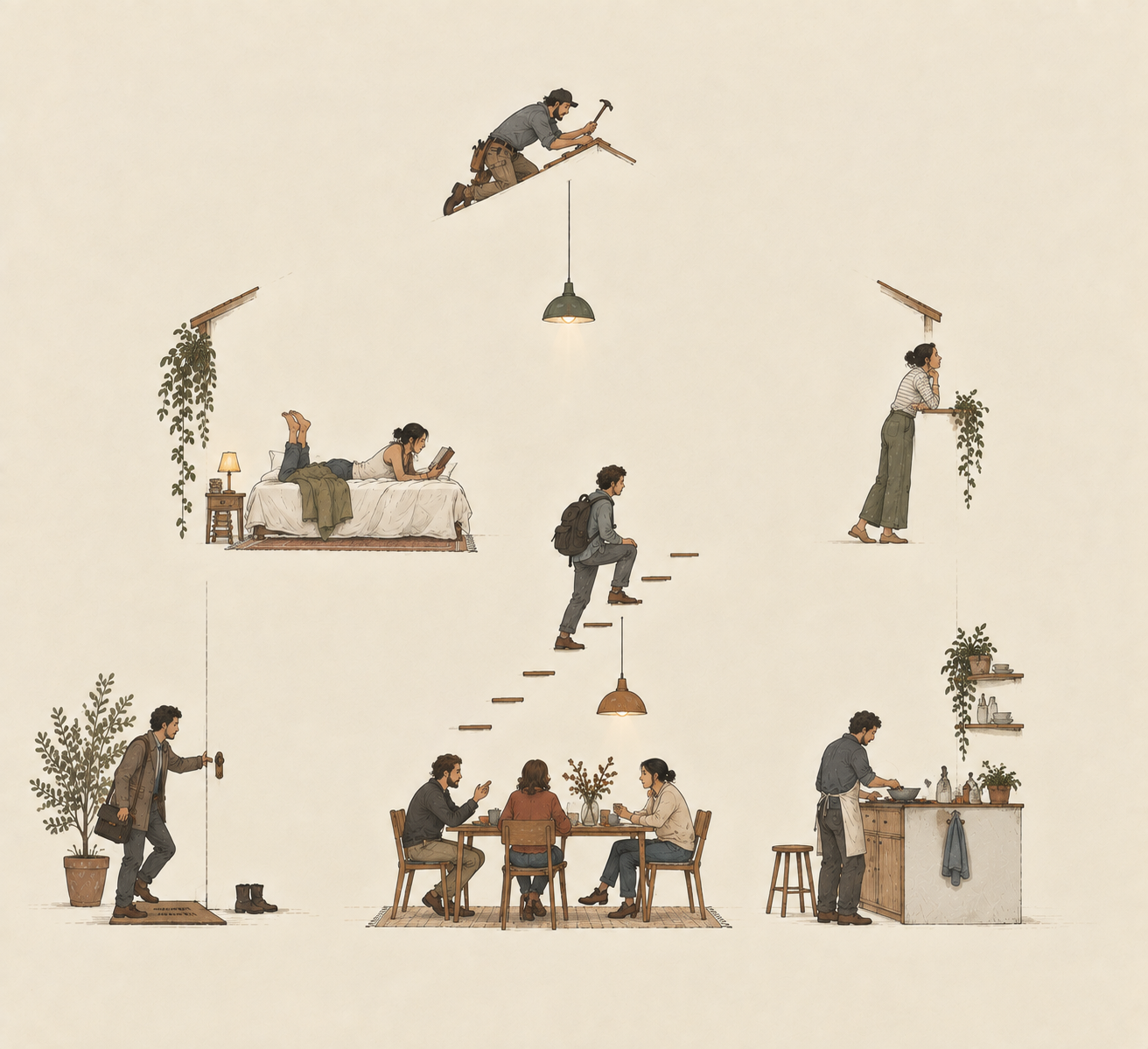
How can we build structures that hold us and keep their walls visible?
We are born into an organised world. The encounter with life demands adaptive compliance, a demand exerted through the daily experience of its boundaries. The historical arrangements that organise those boundaries were there before us and will outlive us, just as they outlived those who contributed to making them. What one generation experienced as a possibility of progress — say, being reachable by email at any hour, even on a plane — falls beneath the horizon of choice for the next, for whom it is simply what the world is and demandsIn conversation with Antonio Gramsci and Georg Lukács.Gramsci shows how historically accumulated forms of common sense can make a social world feel obvious even while remaining contradictory and changeable. Lukács describes reified social relations taking on the appearance of an objective “second nature” to which people adapt. The sentence here is the Wild School’s synthesis of two distinct ideas.In conversation with ↓: Antonio Gramsci · Georg Lukács Antonio Gramsci ↗ · Georg Lukács ↗.
Repeated encounters with those boundaries teach us to anticipate them. Some possibilities feel obvious, others improbable, others somehow not meant for people like us; others never emerge as possibilities at all. Eventually, the boundary no longer needs to announce itself. We no longer need to touch the wall to know where it is. What began as an arrangement becomes a practical sense of how to move through the world, carried in expectation, posture, reflex and habitPierre Bourdieu · habitus and bodily hexis.Bourdieu describes durable dispositions through which social conditions become practical expectations and bodily ways of moving through a world, often without conscious rule-following. Habitus shapes what feels possible or “for us” without functioning as a deterministic script.In conversation with ↓: Pierre Bourdieu Pierre Bourdieu ↗.
Gender, race, class and other social constructions of human ranking have real consequences for where and how we experience the world. Colonial histories, for instance, shape how a person explains and values themselves through the gaze of othersFrantz Fanon · sociogeny and racialised lived experience.Fanon shows racialised self-experience being formed through colonial history, social relations and an imposed racial gaze, while refusing to make that history a complete destiny. This is a specifically colonial and racial argument, not a general theory of all socialisation.In conversation with ↓: Frantz Fanon Frantz Fanon ↗. Yet even under deep social constraints on the identities available to us, the possibility of refusal and self-invention survives.
These boundaries, walls of possibility, together sustain a familiar house that offers a reassuring behavioural domesticity: the house gives us identities (a profession, a personality, a family role) and a dictionary of how others will respond to them. This ‘dictionary of social consequences’ eventually becomes a grammar of the self. These walls travel inward, shaping how we make sense of who we and others are, what we can and should do, and even what life itself is or can be for us. The political, economic and social architecture of the world acquires an interior life that finds its place even in the heart of those oppressed by it. We do not merely inhabit the master's houseAudre Lorde — “The Master’s Tools Will Never Dismantle the Master’s House”Audre Lorde · “The Master’s Tools Will Never Dismantle the Master’s House” (1979)The image of the master’s house comes from Lorde’s argument about difference, power and feminist politics. “We become the house itself” is a Wild School extension of the image, not a quotation or claim from Lorde.In conversation with: Audre Lorde Source ↗. We become the house itself.
Stevens has spent his life trying to become the perfect butler. Looking back on decades at Darlington Hall, he begins to question not only the man he served, but the ideals of dignity, loyalty and service through which he built his own life. Ishiguro’s novel follows the uneasy moment when an inherited social role becomes visible as part of the self that inhabited it.
Unfamiliar experiences have the potential to reveal our unspoken assumptions about ourselves, others and the world. Naming the world anewIn conversation with Paulo Freire.Freire links critical consciousness to dialogue, inquiry and praxis, with learners acting as subjects rather than objects of an expert’s explanation. The phrase “Naming the world anew” is the Wild School’s wording, and unfamiliar experience by itself is not treated here as liberating.In conversation with ↓: Paulo Freire Paulo Freire ↗ opens the possibility of transforming it. In the shared forest of our differences, encounter brings some of our familiar assumptions into view. Boundaries remain real, but some become less inevitable. The edges of our inner world become more porous, and through them fields of possibility for new ways of beingCarl Rogers — A Way of BeingCarl Rogers · A Way of Being (1980)Rogers describes openness to experience as including openness to “new ways of seeing” and “new ways of being.” The Wild School uses the phrase in its own account of possibilities becoming perceptible through encounter.In conversation with: Carl Rogers Source ↗ begin to emerge.
The Wild School works from the radical possibility that together we can make room for the unfamiliar and for the constant possibility of transformation. But we also know that the School creates its own roles, rhythms, norms and forms of authority, which find their way into those who live and learn within it. Our intention is to build practices and structures with enough discipline to keep returning us to curiosity and questioning, preventing our own arrangements from quietly hardening into normality, all while still allowing flow, action, and movement. Social life is impossible without some form of boundaries and walls. Our work together is to keep them visible, so that they help hold our relations together without becoming instruments of domination. Structure is necessary; invisibility is the danger.Wild School synthesisJo Freeman · “The Tyranny of Structurelessness”Freeman argues that rejecting formal structure does not eliminate power; informal structures may instead become harder to see and hold accountable. “Structure is necessary; invisibility is the danger” is Wild School wording, not Freeman’s sentence.In conversation with: Jo Freeman Source ↗
In conversation with
What feels like reality
Antonio Gramsci — common sense / hegemonyReadClose
Antonio Gramsci, Selections from the Prison Notebooks, ed. and trans. Quintin Hoare and Geoffrey Nowell Smith (New York: International Publishers, 1971), especially The Study of Philosophy / passages on common sense and philosophy of praxis. Source ↗
Gramsci treats common sense not as a timeless stock of obvious truths but as historically accumulated, socially situated ways of understanding the world. It is fragmentary, internally inconsistent and composed of elements inherited from different historical periods and social positions. Because people can hold contradictory conceptions and because thought and practical activity can diverge, common sense is neither a perfectly coherent ideology nor a sealed container. The philosophy of praxis begins from critical engagement with this already-existing activity rather than installing thought into passive people from scratch.
Karl Marx — commodity fetishismReadClose
Karl Marx, Capital: A Critique of Political Economy, vol. I, ch. 1 §4, The Fetishism of Commodities and the Secret Thereof (first German ed. 1867; English eds vary).
Marx asks why relations among producers, organised through commodity exchange, appear to people as objective properties and relations of the commodities themselves. The social character of labour takes a thing-like form. Categories specific to commodity production can therefore acquire the appearance of natural or self-evident characteristics of economic life even though they belong to a historically specific mode of production.
Georg Lukács — reification / second natureReadClose
Lukács, G. (1971 [1923]). “Reification and the Consciousness of the Proletariat.” In History and Class Consciousness: Studies in Marxist Dialectics, trans. Rodney Livingstone. Cambridge, MA: MIT Press. Source ↗
Lukács extends Marx’s analysis of commodity fetishism into a wider account of social life in which human activity and relations acquire a thing-like, apparently independent objectivity. Rationalised institutions can confront people as finished mechanisms to which they must adapt, while the same process can shape subjective life through self-objectification and habitual adjustment. He describes this social world as a kind of “second nature,” although his analysis also identifies contradictions and limits within the apparently complete rationalised order.
Frantz Fanon, Peau noire, masques blancs (Paris: Éditions du Seuil, 1952), especially Introduction, ch. V L'expérience vécue du Noir, and Conclusion. English translations should be named if quoted. Source ↗
Fanon rejects an account of Black experience that can be reduced to individual psychology. Alongside phylogeny and ontogeny he introduces sociogeny: racialised self-experience is formed through historical and social relations. In the chapter on lived Black experience, the body is encountered through a racial-historical schema produced in relation to a white world; the gaze and inherited stories can force self-experience into objectification. Yet Fanon's conclusion explicitly rejects becoming a prisoner of history and insists on invention and ongoing self-creation.
Pierre Bourdieu — habitus / practical belief / bodily hexisReadClose
Pierre Bourdieu, The Logic of Practice, trans. Richard Nice (Stanford: Stanford University Press, 1990), especially ch. 3 Structures, Habitus, Practices and ch. 4 Belief and the Body. Source ↗
Bourdieu develops habitus as durable, transposable dispositions formed through social conditions and repeated practice. These dispositions generate practices that can be regular and fitted to circumstances without conscious rule-following. Possibilities and impossibilities can therefore become practical expectations: some actions feel obvious, probable, unthinkable or not for us. In Belief and the Body, practical belief is not merely assent to ideas but a bodily, pre-reflective relation to a field; social necessity can become motor schemes, posture, language and automatisms.
Kazuo Ishiguro — role / dignity / self formed through serviceReadClose
Ishiguro, Kazuo. The Remains of the Day. London: Faber and Faber, 1989. Primary text consulted in the Charnwood Library large-print edition (F. A. Thorpe, 1990), by arrangement with Faber & Faber Limited. Source ↗
Ishiguro's novel follows Stevens, an ageing English butler who leaves Darlington Hall for a six-day journey through the West Country in 1956. As he travels, his account repeatedly returns to his decades of service to Lord Darlington, his understanding of professional dignity, his relationship with the housekeeper Miss Kenton, and the choices through which service came to organise much of his life. Stevens has understood dignity through restraint, loyalty and the ability to subordinate personal feeling to his professional role; he also trusted his employer to make the larger moral and political judgements to which his own work contributed. Looking back, that confidence becomes increasingly difficult to sustain. The journey gradually exposes the distance between the life Stevens believed he was choosing and possibilities, relationships and responsibilities he had scarcely allowed himself to consider.
Empirical guardrails
Leonardo Bursztyn, Alessandra L. González & David Yanagizawa-Drott — misperceived social norms / pluralistic ignoranceReadClose
Misperceived Social Norms: Women Working Outside the Home in Saudi Arabia, American Economic Review 110(10) (2020): 2997–3029. DOI: 10.1257/aer.20180975 ↗.
In a sample of young married men in Riyadh, most participants privately supported women working outside the home while substantially underestimating comparable men's support. Randomised correction of those beliefs increased men's willingness to help their wives search for jobs, and later outcomes showed increased applications/interviews. A separate recruitment experiment also tested the effects of information about actual support. The study documents a gap between private attitudes and perceived injunctive norms and shows that correcting misperceptions can alter behaviour.
Hazel Rose Markus & Shinobu Kitayama — mutual constitution of culture and selfReadClose
Cultures and Selves: A Cycle of Mutual Constitution, Perspectives on Psychological Science 5(4) (2010): 420–430. DOI: 10.1177/1745691610375557 ↗.
Markus and Kitayama describe culture not simply as beliefs stored inside individuals but as patterns of ideas, practices, institutions, products and artefacts that are continually made and remade through human activity. Selves develop within these cultural worlds and in turn reproduce or change them. They review evidence on independent and interdependent forms of self, while stressing that both are available within persons and that cultural patterns are dynamic rather than homogeneous.
Governing image
Audre Lorde — master’s tools / inherited forms of dominationReadClose
Lorde, A. (1984 [1979]). “The Master’s Tools Will Never Dismantle the Master’s House.” In Sister Outsider: Essays and Speeches. Trumansburg, NY: Crossing Press. Source ↗
Lorde’s essay challenges feminist theory and organising that seek transformation while reproducing exclusions around race, sexuality, class and age. She argues that differences among women cannot simply be ignored or absorbed into dominant categories, and that the practices and relations of an oppressive order cannot by themselves produce fundamental change. Her image of the “master’s tools” and “master’s house” emerges from this argument about difference, power and the limits of liberation organised through inherited structures.
Naming and critical inquiry
Ignacio Martín-Baró — de-ideologisation of everyday experienceReadClose
Ignacio Martín-Baró, Hacia una psicología de la liberación, Boletín de Psicología 22 (1986): 219–231, UCA Editores. Source ↗
Martín-Baró argues that Latin American psychology has often individualised problems rooted in histories of dependency and oppression. One task of a liberation psychology is to de-ideologise everyday experience: to examine forms of common sense that conceal or justify dominant interests and to recover people's lived experience and historical memory through critical participation rather than imposing imported psychological schemes. Knowledge is treated as socially situated and as something that must be tested in relation to the reality of popular sectors.
Paulo Freire — conscientisation / dialogue / praxisReadClose
Paulo Freire, Education for Critical Consciousness (English first published 1973; composed from Education as the Practice of Freedom and Extension or Communication), plus Pedagogy of the Oppressed as wider genealogy. Source ↗
Freire opposes education that treats learners as objects to be acted upon. Critical consciousness develops through dialogical engagement with concrete existence, inquiry and participation. Education should help people become subjects able to intervene in history rather than adapt passively to an imposed order; disconnected verbalism and the dictation of ideas work against this. His account therefore joins reflection to practice rather than treating critical awareness as information delivered by an expert.
Enrique Dussel — exteriority / limits of totalityReadClose
Dussel, E. (1985). Philosophy of Liberation. Trans. Aquilina Martinez & Christine Morkovsky. Maryknoll, NY: Orbis Books. Source ↗
Dussel’s Philosophy of Liberation develops a critique of philosophical systems that treat their own horizon as the whole of reality. His category of “exteriority” begins from persons and peoples whose existence, speech and experience cannot be fully contained by the dominant system’s categories. Liberation therefore requires attending to what a totality excludes or renders unintelligible, rather than assuming that the existing map of reality can completely describe those who live within and beyond it.
Jacques Rancière — intellectual equality / emancipation without explanationReadClose
Rancière, J. (1991). The Ignorant Schoolmaster: Five Lessons in Intellectual Emancipation. Trans. Kristin Ross. Stanford, CA: Stanford University Press. Source ↗
Rancière recounts the nineteenth-century teacher Joseph Jacotot’s experiments to challenge a familiar assumption of pedagogy: that learners require an explaining intelligence to lead them from ignorance to understanding. He argues that explanation can reproduce intellectual hierarchy when it begins by presuming the learner’s incapacity and makes emancipation dependent on the person who claims to overcome it. Against this, the book treats equality of intelligence as a presupposition to be enacted and tested rather than a status an educator eventually grants to a learner.
Carl Rogers — openness to experience / new ways of beingReadClose
Rogers, C. R. (1980). A Way of Being. Boston, MA: Houghton Mifflin. Relevant section: “The World of Tomorrow, and the Person of Tomorrow.” Source ↗
In A Way of Being, Carl Rogers develops his person-centred understanding of human growth beyond psychotherapy into education, relationships, community and social change. In “The World of Tomorrow, and the Person of Tomorrow,” he describes people capable of living amid change as open to experience and to new ways of seeing and being, oriented toward authenticity, process and self-direction rather than rigid conformity. Rogers presents persons not as fixed entities but as capable of continuing change, while emphasising relational and social conditions that can either constrain or support that openness. His account is explicitly hopeful and speculative rather than a theory that transformation automatically follows from unfamiliar experience.
Institutional return
Jo Freeman — informal power / structurelessnessReadClose
Freeman, J. (1972–73). “The Tyranny of Structurelessness.” Berkeley Journal of Sociology, 17, 151–165. Earlier version first officially published in The Second Wave, 2(1), 1972. Source ↗
Freeman argues that groups cannot eliminate structure simply by refusing formal organisation. Informal networks, friendship patterns, access to information and unacknowledged influence still shape decisions, but can become harder to identify and hold accountable when a group describes itself as structureless. She therefore distinguishes resistance to rigid or excessive hierarchy from the fantasy of having no structure, and proposes explicit, democratic forms of organisation that make authority, responsibility and participation more visible.