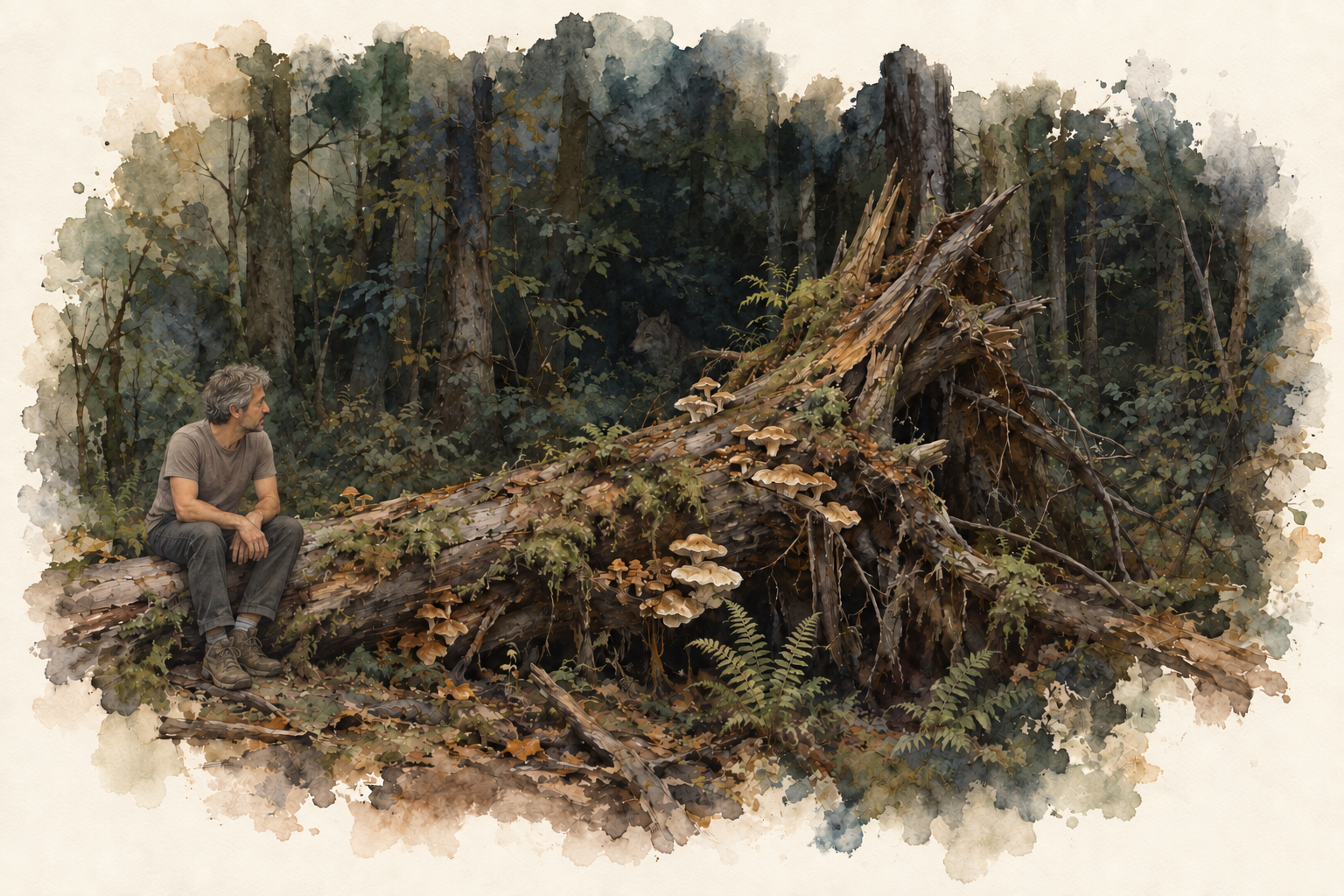
There is a necessary premise to the conversation we are about to have on the position of human beings in the universe. That premise starts by asking who, historically, has been allowed to count as human and who has considered themselves to be at the centre. We know that the historically specific Western bourgeois figure of ManSylvia Wynter — “Unsettling the Coloniality of Being/Power/Truth/Freedom: Towards the Human, After Man, Its Overrepresentation—An Argument” (2003)Wynter uses Man for historically specific Western genres of the human that came to be overrepresented as though they were humanity itself. Her argument distinguishes those genres from the human species and traces their formation through colonial and racial ordering.In conversation with: Sylvia Wynter
Source ↗ came to overrepresent itself as human, and that colonial and racial orders created hierarchies among humans, and between humans and non-humansMaría Lugones — “Toward a Decolonial Feminism” (2010)Lugones argues that colonial modernity imposed a hierarchical distinction between the fully human and colonised peoples cast toward animality or non-humanity. This hierarchy forms part of her wider account of race, gender and coloniality.In conversation with: María Lugones
Source ↗, in relation to that figure. The history of anthropocentrism is therefore one that first needs to be decolonised, not with the intention of returning to a romantic pre-colonial origin, but to avoid reproducing its mistakes and horrors.
Calling into question the idea that humans have a central place in the universe is not a project of reducing their dignity, agency, or meaningfulness. In fact, dislodging the presumption of human sovereignty increases the possibility of attunement to life itself, deepening our intimate connection with the natural world and allowing us to re-enter it. Not because we ever physically left it, but because we had learned to place ourselves ontologically, emotionally, and cognitively outside it, becoming its masters and consumers.
Decolonising our relationships to heal them of extraction, dehumanisation, and violence will not, by itself, demand the abdication of humanity’s self-assigned primacy over nature. A commons can still be anthropocentric: it can transform who among humans is able to use and benefit from the world without questioning the deeper presumption that the world is there for human use and benefit. That's why we need to enter the wild.
The survival of the concept of humans as beings outside nature, even in socially just spaces, does not come as a surprise. It need not depend on a conscious desire to subjugate nature. It can persist through forms of everyday life in which ecological processes and dependencies are heavily mediated and often hidden from ordinary viewMaria Kaika — “Interrogating the Geographies of the Familiar: Domesticating Nature and Constructing the Autonomy of the Modern Home” (2004)Kaika shows how the modern home remains materially dependent on water, energy, sewage and other socio-natural networks while infrastructures can keep many of those processes outside ordinary perception, helping the home appear more autonomous from nature than it is.In conversation with: Maria Kaika
Source ↗. Water arrives through a tap, food through a supermarket, waste disappears through pipes and trucks, and energy through a socket: the infrastructures that sustain us can backgroundVal Plumwood — Feminism and the Mastery of Nature (1993)Plumwood uses backgrounding for a relation in which a dominant identity depends upon a subordinated sphere while denying, minimising or making that dependence less visible.In conversation with: Val Plumwood
Source ↗ our belonging to and dependence on the natural world, making them disappear from view, while instrumentalisationVal Plumwood — “Nature, Self, and Gender: Feminism, Environmental Philosophy, and the Critique of Rationalism” (1991) · Val Plumwood — Feminism and the Mastery of Nature (1993)In Plumwood’s critique of anthropocentrism, instrumentalisation treats another being or sphere primarily in relation to the dominant party’s purposes, obscuring forms of value and agency not reducible to those ends.In conversation with: Val Plumwood · Val Plumwood
Source ↗ · Source ↗ encounters non-human beings primarily through the purposes they serve for us.
Drawing value from the natural world to meet human needs is not in itself a problem. Humans have long hunted deer for food, drunk from springs for water, and burned wood for warmth. We are still doing this; food, water, and warmth are simply separated by many more steps from the deer, the spring, and the wood from which they ultimately come. The problem arises when something is given value only as a function of its usability to us. Then the distortion becomes: a deer has value only as flesh, a tree as paper, a mountain as quarry.
One way of interrupting this reduction is to change the purpose of the encounter itself. A mountain can be approached as a summit to conquer, stone to extract, scenery to consume, or terrain to cross. But it can also be returned to, walked within, slept on, felt through weather, water, rock, fatigue, orientation, fear, and familiarity—becoming more rather than less inexhaustible as we know it better. Intimacy begins to replace mastery when arriving, extracting, or achieving stops being the measure of the encounter.Val Plumwood — “Nature, Self, and Gender: Feminism, Environmental Philosophy, and the Critique of Rationalism” (1991) · Val Plumwood — Feminism and the Mastery of Nature (1993)In conversation with Val Plumwood. Her critique of mastery and instrumentalisation examines relations in which a dominant identity treats another being or sphere chiefly in terms of its own ends. This sentence is Wild School synthesis rather than Plumwood’s wording.In conversation with: Val Plumwood · Val Plumwood
Source ↗ · Source ↗
If value is not exhausted by usefulness, then what matters to us in its own right: sentient animals, all living beings, rivers, mountains, whole species, ecosystems, or ecological wholes? Some have suggested that humans should extend moral consideration outwards according to qualities we recognise in ourselves: the capacity to sufferPeter Singer — “All Animals Are Equal” (1974)Singer argues that the capacity for suffering and enjoyment gives a being interests that must enter moral consideration. Equal consideration does not mean identical treatment or identical rights for beings with different capacities.In conversation with: Peter Singer
Source ↗, to feel, to think, to communicate, or to act intentionally. So, for instance, animals we recognise as capable of suffering may be protected from unnecessary harm, while much less consideration is extended to the annoying mosquito, or to the weed in the garden. This can radically widen the circle of moral concern while still leaving the human quietly at its centre, because other beings acquire significance according to how closely they resemble capacities we have privileged in ourselves. If the human is not the measure, resemblance to the human cannot be the only measure of what matters.
Other intellectual traditions begin elsewhere. In the Anishnaabe and Haudenosaunee traditions discussed by Watts, place is not an inert setting to which humans subsequently give meaning: land and thought are not first separate, and agency is not exclusively humanVanessa Watts — “Indigenous Place-Thought & Agency Amongst Humans and Non-Humans” (2013)Watts develops Place-Thought through Anishnaabe and Haudenosaunee intellectual contexts in which place and thought are not first independent domains and agency is not restricted to humans. The concept should not be generalised into a single “Indigenous worldview.”In conversation with: Vanessa Watts
Source ↗. A river, mountain, animal, plant, or landscape therefore does not first have to resemble a human or another sentient animal before entering the field of relation. Such places and beings can shape the lives of communities across generations and even millennia—orienting movement, memory, subsistence, story, obligation, and identity for far longer than any single person can. Seen from within such relations, it becomes easier to understand why some traditions encounter particular rivers, forests, mountains, or waters not merely as resources or scenery, but as persons, spirits, ancestors, or divinities. If I recognise moral value in someone who crosses paths with me once, why wouldn’t I do the same for the tree that crosses paths with me every morning?
Taking such relations seriously also asks us to experiment with new ways of being in relationship with the wild. A mountain can become an earth-beingMarisol de la Cadena — “Indigenous Cosmopolitics in the Andes: Conceptual Reflections beyond ‘Politics’” (2010)De la Cadena uses earth-beings in analysing Andean political worlds where mountains, water and soil can enter collective action without being reduced either to natural resources or to cultural beliefs about an otherwise neutral nature.In conversation with: Marisol de la Cadena
Source ↗, a waterfall a divinity speaking through laughter, and mushrooms older brothers that facilitated life. Different worlds can remain different and stay alive and in relation across different ways of being present to them.
The field of relation is not one-way: we are not the gardeners of heaven. Ecological interdependence does not wait for our care in order to exist; the ethical question is how we inhabit the relations that already sustain us. Contemporary Yorùbá environmental philosophy describes reciprocal care through mutual courteousnessAanuoluwapo Fifebo Sunday — “Addressing More-than-Human Care through Yorùbá Environmental Ethics” (2025; first published online 2024)Sunday develops mutual courteousness as a contemporary Yorùbá environmental-philosophical account of reciprocal more-than-human care, focusing especially on water and Ọ̀ṣun. It is her philosophical formulation, not the name of an undifferentiated timeless Yorùbá doctrine.In conversation with: Aanuoluwapo Fifebo Sunday
Source ↗: humans sustain, constrain, affect, and sometimes overwhelm waters, soils, plants, animals, and places that sustain, constrain, affect, and sometimes overwhelm them.
Here, the wild does not mean a pristine nature from which humans are absentWilliam Cronon — “The Trouble with Wilderness; or, Getting Back to the Wrong Nature” (1995/1996)Cronon criticises the ideal of wilderness as pristine nature outside human history and civilisation, arguing that it can reproduce the separation between an authentic nature “out there” and the inhabited places where people actually live.In conversation with: William Cronon
Source ↗. That fantasy can reproduce the very separation we are trying to leave behind: humans here, wilderness elsewhere. The wild names instead what remains capable of exceeding human design, interpretation, and control. It can be present in a forest, a garden, a cityKathleen Dean Moore — “The Moral Equivalent of Wildness” (2005)Moore distinguishes legally bounded wilderness from a wildness she comes to see as present in ordinary material life as well as remote landscapes—in weather, air, water, bodies and cities.In conversation with: Kathleen Dean Moore
Source ↗, another animal, a human body, or a river running through concrete. Participation need not mean leaving the world untouched: cultivating, harvesting, restoring, tending, and protectingEnrique Salmón — “Kincentric Ecology: Indigenous Perceptions of the Human–Nature Relationship” (2000)Salmón describes Rarámuri ecological relations that can include harvesting, cultivation, burning, pruning, transplanting and tending. Human intervention is not absent, but is situated within long familiarity with particular places, species and regenerative capacities.In conversation with: Enrique Salmón
Source ↗ can belong to intimate relation when our actions remain responsive to what a place and its beings allow. What makes it wild is not that we have never touched it, but that our touch does not exhaust what it can become.
In the relational reciprocity of the cosmos, other beings and systems remain other to us. The existence and meaning of a forest, an animal, a river, or a mountain exceed the ways through which humans encounter them; their existence is never exhausted by their relation to usVal Plumwood — “Nature, Self, and Gender: Feminism, Environmental Philosophy, and the Critique of Rationalism” (1991) · Val Plumwood — Feminism and the Mastery of Nature (1993) · Deborah Bird Rose — “Val Plumwood’s Philosophical Animism: Attentive Interactions in the Sentient World” (2013)In conversation with Val Plumwood and Deborah Bird Rose. Plumwood argues that overcoming human/nature hierarchy need not absorb the non-human other into an enlarged human self. Rose’s account of attentive interaction likewise treats participatory knowledge as situated and incomplete: relation does not make another being fully transparent to us. The sentence here remains Wild School synthesis.In conversation with: Val Plumwood · Val Plumwood · Deborah Bird Rose
Source ↗ · Source ↗ · Source ↗. To leave the human centre is to come into intimacy with the wild, the uncontrolled, the unmanicured: with the recognition that life does not need us to define itself, even as it can stand in definitional relation with us.
Perhaps one of the deepest affronts to human arrogance is the intimate realisation that we are edibleVal Plumwood — The Eye of the Crocodile (2012), especially “Meeting the Predator” and “The Wisdom of the Balanced Rock”Plumwood’s prey perspective begins from the recognition that humans are edible animals within ecological food relations, not only consumers standing outside them. Her crocodile encounter becomes the basis for challenging human exceptionalism around predation and death.In conversation with: Val Plumwood
Source ↗. We encounter the food web from the position of the eater, but the wild does not recognise the exemption we grant ourselves. Under different conditions, our eating body will itself become food.
Living in intimacy with the wild also means accepting the cycles of life and death in which we participate. Life feeds on life; bodies age, suffer, are injured, decay, and die, while fungi, microorganisms, plants, and other beings turn what has died into conditions for life againVal Plumwood — “Tasteless: Towards a Food-Based Approach to Death” (2008)Plumwood develops a food-based account of death in which human bodies remain material participants in ecological relations and can nourish other life, challenging cultural narratives that exempt humans from the ordinary circulation of food and decomposition.In conversation with: Val Plumwood
Source ↗. Predation, killing, decomposition, and regeneration are part of ecological interdependence. They need to be acknowledged not to find a romantic justification of violence as “natural,” but for precisely the opposite reason: to resist the fantasy that being in ethical relation with the whole means inhabiting a universe without harm and sufferingDeborah Bird Rose — “Val Plumwood’s Philosophical Animism: Attentive Interactions in the Sentient World” (2013)In conversation with Deborah Bird Rose. Her account of attentive interaction includes predator and prey, beings that hunt, evade, kill and are killed. Ecological participation is therefore not presented as a world without danger or death. This does not make natural violence a moral model for human action.In conversation with: Deborah Bird Rose
Source ↗. Death is not an error outside the processes of life; it participates in the transformations through which living systems continually become otherwise. The question as we enter the wild is not how we conquer death, but how we avoid unnecessarily amplifying suffering across the ecology while accepting our participation in relations that inevitably involve consumption, loss, and death. The wild is not good or gentle; it is chaotic, true, and alive, including in its relationship with death.
Intimacy makes loss felt.Linda Hogan — “The Healing of Wild Horses: Our Truths Come From Tenure on This Land” (2011)In conversation with Linda Hogan. Hogan’s essay holds animal relationship, Chickasaw histories of displacement, disappearing species, damaged land and ecological restoration in the same field of lived relation. The language of ecological grief in this passage is Wild School synthesis, not a quotation or doctrine attributed to Hogan.In conversation with: Linda Hogan
Source ↗ The disappearance of a species, the clearing of a forest, or the silencing of an animal once familiar to a place is the end of a relation. Grief can belong to ecological intimacy with the wild: not because the beings we grieve belonged to us, but because relation makes us vulnerable to and within their disappearance.
Intimacy with the wild requires attention. To encounter the wild is difficult if everything that appears before us is immediately managed or translated into our plans, fears, projections, and desires. Contemplative attention slows the pace of interpretation: something outside us becomes sufficiently present that, for a moment, we become more present to it than to our own preoccupationsIris Murdoch — The Sovereignty of Good (1970)A floorboard for this passage is Iris Murdoch’s account of unselfing. Murdoch describes attention shifting away from self-preoccupied fantasy toward something real and independent of the observer; her kestrel example is one occasion of that shift. She does not claim that contact with nature reliably makes people morally better.In conversation with: Iris Murdoch
Source ↗. Relational attention allows us to learnDeborah Bird Rose — “Val Plumwood’s Philosophical Animism: Attentive Interactions in the Sentient World” (2013) · Nurit Bird-David — “‘Animism’ Revisited: Personhood, Environment, and Relational Epistemology” (1999)Rose develops attentive interaction and active listening as forms of situated participation, while Bird-David describes relational epistemology, in which knowledge can be cultivated through ongoing relations and practices that educate attention.In conversation with: Deborah Bird Rose · Nurit Bird-David
Source ↗ · Source ↗ through the differences and mysteries we encounter in the wild.
That intimacy is not exhausted by knowing the wild; it is also an act of unknowing it: relinquishing the expectation that the reality we encounter there, including ourselves, can be possessed through concepts and categoriesNurit Bird-David — “‘Animism’ Revisited: Personhood, Environment, and Relational Epistemology” (1999) · Marisol de la Cadena — “Indigenous Cosmopolitics in the Andes: Conceptual Reflections beyond ‘Politics’” (2010)In conversation with Nurit Bird-David and Marisol de la Cadena. Bird-David’s relational epistemology treats ongoing relation as a way of knowing rather than the opposite of knowledge. De la Cadena’s partial connections show how different worlds can enter relation without being made fully commensurable inside one conceptual frame. This passage remains Wild School synthesis.In conversation with: Nurit Bird-David · Marisol de la Cadena
Source ↗ · Source ↗. Much of our waking life is already spent naming, analysing, interpreting, calculating, comparing, and organising a world increasingly manicured for human purposes. We do not need to enter the wild simply to acquire more knowledge. We remain in relation with what, in the deep wild, exceeds our capacity to comprehend fully because we are no longer seeking mastery or conceptual ownership. As we enter the wild, literally and metaphorically, we loosen the expectation that cognitive knowing can exhaust what we encounter and remain open to emergent relational wisdom.
As we enter the wild with attention and grow intimate with it, the wild enters us and passes through us. Our bodies grow, desire, heal, age, become ill, reproduce, transform, and die through processes that are never entirely ours to command. Emotions, dreams, intuitions, impulses, and relationships also move through us beyond the reach of rational control alone. To become intimate with the wild is then to become intimate with the uncontrollable, the unmanicurable, the ungardenable: the dark force of life itself moving through the chaos of existence.