How can we rest in enoughness and remain open to becoming?
How much is enough? Human survival and security depend upon the satisfaction of inescapably material conditions. A person needs enough to eat, keep a roof over their head, see a doctor, care for a child, withstand an unexpected loss, or leave work or a relationship that has become unsafe. There is nothing romantic about resource deprivation: access to the resources and protections a person needs affects one's room to actAmartya Sen — Development as Freedom (1999)Sen evaluates development through substantive freedom: people's real opportunities to do and be what they have reason to value. Room to act is Wild School wording for this capability-oriented distinction between possessing resources and having genuine possibilities.In conversation with ↓: Amartya Sen Source ↗, widening what a person can realistically do, refuse, recover from, and plan for.
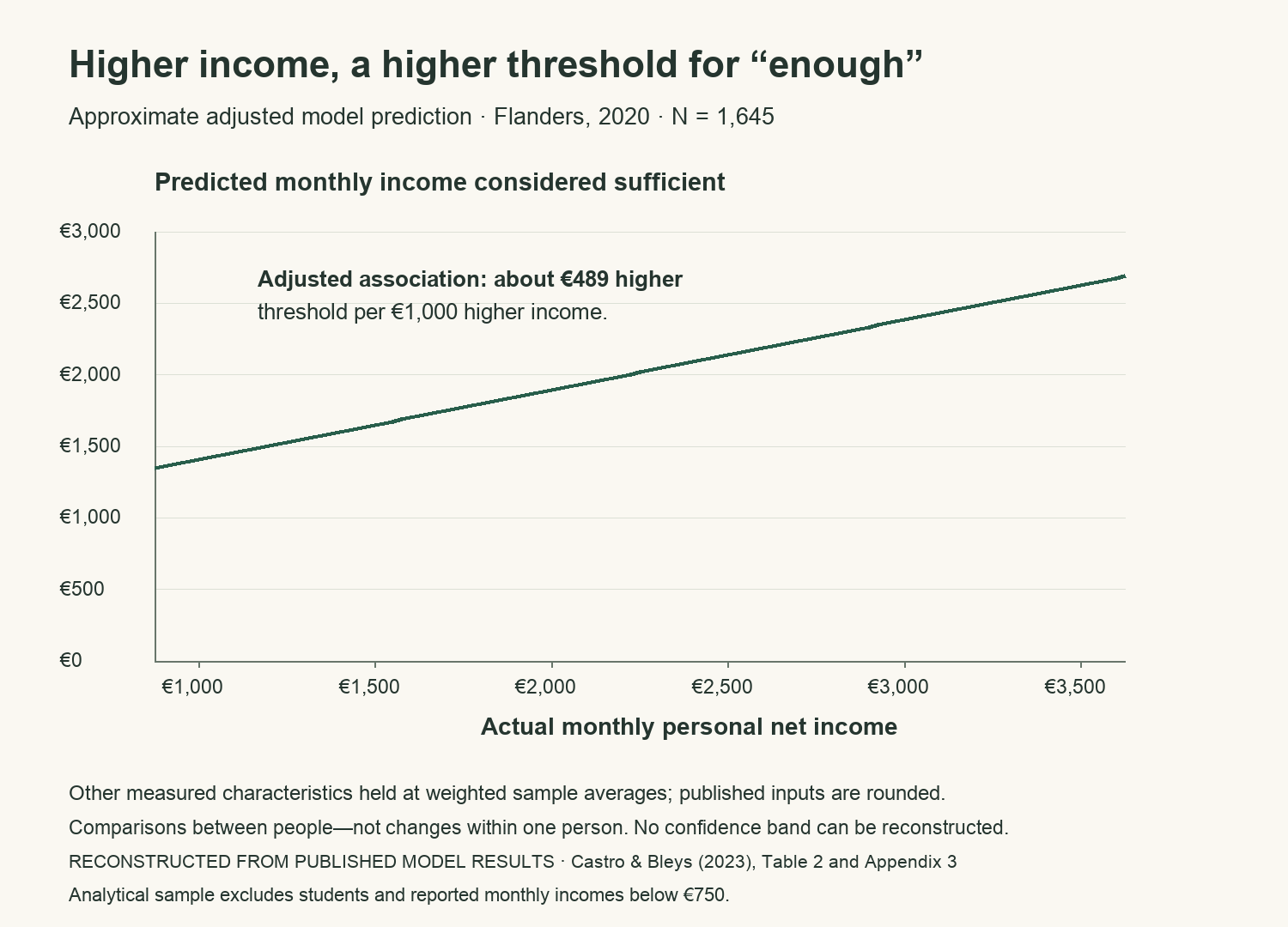
But the amount of resources a person has does not by itself answer the question of whether they feel they have enough. The conditions that allow us to live securely and those that allow us to feel secure are not necessarily the same. In a study of financial sufficiencyCastro & Bleys · subjective income sufficiency.In their Flanders survey, higher income was associated both with judging present income more sufficient and with naming a higher income level as “enough.” These are adjusted cross-sectional associations, not evidence that an individual’s threshold necessarily rises when their income rises.In conversation with ↓: Castro & Bleys Castro & Bleys ↗, people with higher incomes, compared with those on lower incomes, tended both to feel that their present income was more sufficient and to set a higher threshold for what counted as enough. More money was therefore associated with a greater sense of “I have enough” and, at the same time, with a higher estimate of “how much is enough.”
Approximate adjusted model prediction of monthly personal net income considered sufficient, reconstructed from published Table 2 coefficients and Appendix 3 weighted covariate averages in Castro & Bleys (2023), Flanders 2020 (N=1,645). Other measured characteristics are held at weighted sample averages. The line compares people, not changes within one person, and does not depict observed income-group averages. Published inputs are rounded; no confidence band can be reconstructed.
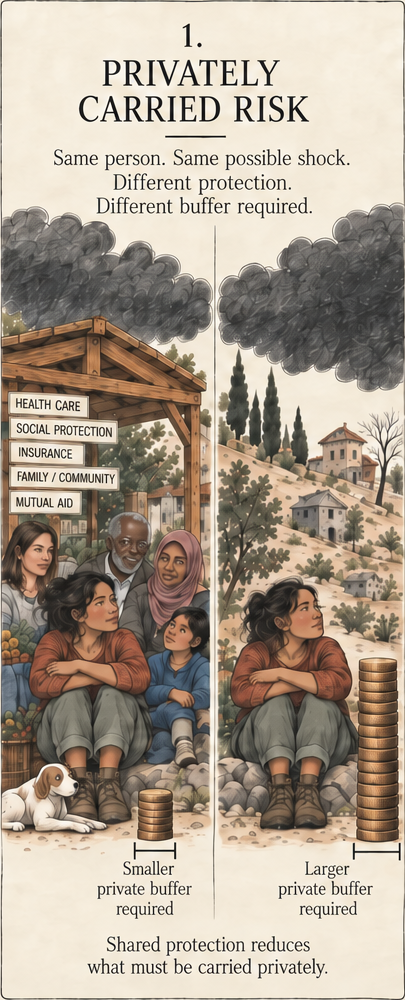
The internal experience of (real or feared) scarcity is socially organised. Scarcity anxiety is shaped by how much risk one is required to carry privatelySeverin Rapp & Stefan Humer — “Wealth and Welfare: Do Private and Public Safety Nets Compensate for Asset Poverty?” (2023) · Shin-Yi Chou, Jin-Tan Liu & James K. Hammitt — “National Health Insurance and precautionary saving: evidence from Taiwan” (2003) · Andrew Benito — “Does job insecurity affect household consumption?” (2006)These studies show different ways institutional protection changes private precaution: welfare-state benefits alter how much household wealth is needed to withstand income loss; expanded health insurance reduced precautionary saving in Taiwan; and job insecurity is associated with more cautious household consumption. Together they support the bounded claim that some risks can be shifted between collective institutions and private households.In conversation with ↓: Severin Rapp & Stefan Humer · Shin-Yi Chou, Jin-Tan Liu & James K. Hammitt · Andrew Benito Source ↗ · Source ↗ · Source ↗. If access to housing, healthcare, care in old age, education, or protection from unemployment depends heavily on one's own income and savings, private resources act as self-insurance against the possible unravelling of several parts of life at once. In the absence of institutions able to absorb those risks, the contemporary disintegration of the collective social fabric deepens dependence on money further. As forms of care and practical support once carried through relationships and reciprocal obligations recedeShahra Razavi — “The Political and Social Economy of Care in a Development Context” (2007) · Eric Bonsang — “Does informal care from children to their elderly parents substitute for formal care in Europe?” (2009) · Atul Gawande — Being Mortal (2014)Razavi maps care across households, states, markets and communities; Bonsang shows that informal and formal elder-care provision can substitute for or complement one another depending on need; Gawande describes how changing family arrangements redistribute dependence and care work. Together they support the claim that care needs can persist while the relation through which they are met changes.In conversation with ↓: Shahra Razavi · Eric Bonsang · Atul Gawande Source ↗ · Source ↗ · Source ↗, those needs increasingly have to be met through private purchase where collective or public provision does not take their place.
Scarcity anxiety is not only generated by insufficient protections; it is also socially learnt. Desire can be mimetic:René Girard — Deceit, Desire, and the Novel: Self and Other in Literary Structure (1965 English edition)Girard develops mediated or triangular desire: another person can function as a model whose own valuation helps make an object appear desirable. Unit III uses this heuristically as one account of socially mediated wanting, not as a universal theory that all desire is mimetic.In conversation with ↓: René Girard Source ↗ other people can become models of desire, their own wanting helping to make particular objects, achievements or ways of life appear worth wanting. In this wider social field, personal thresholds of enoughness are mapped in relation to the world around us: the incomes of neighbours and colleagues, the image of success we feel required to perform in the theatre, and the aspirations against which we measure our own. People's income aspirationsAlois Stutzer — “The Role of Income Aspirations in Individual Happiness” (2004) · Matti Hovi & Jani-Petri Laamanen — “Income, aspirations and subjective well-being: International evidence” (2021)Stutzer finds that income aspirations rise with people's own income and the income of others around them, while higher aspirations are associated with lower life satisfaction at a given income. Hovi and Laamanen likewise find aspirations responding to changes in own and others' income across international data.In conversation with ↓: Alois Stutzer · Matti Hovi & Jani-Petri Laamanen Source ↗ · Source ↗, for example, have been found to rise with the incomes of others around them.
In other words, not-enoughness can be reproduced in different ways: by systems that leave people exposed to risk, by social maps of expectation that continually reshape what counts as sufficient, and by forms of human craving that renew themselves even after particular wants have been satisfied. In early Buddhist traditions, taṇhāEarly Buddhist tradition — Raṭṭhapāla Sutta (MN 82) · Dhammapada 186–187 and 334–338These texts portray taṇhā as craving that is not reliably stilled by acquisition and can renew itself around further objects. The chapter uses this as a Buddhist ethical-soteriological account of craving, not as evidence that every form of desire or aspiration is pathological.In conversation with ↓: Early Buddhist tradition · Dhammapada Source ↗ · Source ↗ · Source ↗ names a form of craving that is not stilled by obtaining what it craves. Getting what we want may satisfy the immediate want without satiating the craving; the craving can remain and attach itself to something else.
Unsated craving is not confined to material goods: it can attach itself to status, belonging, power, recognition, autonomy, or even spiritual attainment. Experiences of social exclusionNicole L. Mead et al. — “Social Exclusion Causes People to Spend and Consume Strategically in the Service of Affiliation” (2011)Across four experiments, excluded participants altered consumption when particular goods or spending could plausibly support social reconnection. The finding concerns strategic affiliation-oriented consumption, not a general claim that exclusion simply makes people consume more.In conversation with ↓: Nicole Mead et al. Source ↗ can make goods associated with affiliation more attractive when they appear to promise some of the belonging that is missing. Among highly materialistic consumers, even the anticipation of acquiring somethingMarsha L. Richins — “When Wanting Is Better than Having: Materialism, Transformation Expectations, and Product-Evoked Emotions in the Purchase Process” (2013)Richins finds that highly materialistic consumers report particularly strong positive emotion while anticipating desired acquisitions and often expect purchases to transform their lives; those emotions decline after acquisition. This is population-bounded evidence, not a universal law of wanting.In conversation with ↓: Marsha Richins Source ↗, the thrill of the personal transformation the purchase seems to promise, can generate more positive emotion than having it. A yoga mat can become a promise of finally becoming the spiritual person one imagines oneself to be. Accumulation can therefore continue far beyond material need, towards status, power and position. Not-enoughness is a travelling story: it can inhabit our sense of whether our possessions are adequate just as much as our sense of whether we ourselves are.
Commercial systems profit from this field of desire by attaching social and personal meanings to products, shifting the standards against which we judge ourselves, and making scarcity itself desirable. Idealised advertisingMarsha L. Richins — “Social Comparison and the Idealized Images of Advertising” (1991)Richins shows that exposure to idealised advertising images can alter comparison standards and reduce self-evaluation within the tested domain of physical attractiveness. The chapter uses this as bounded evidence that advertising can shift standards against which people judge themselves.In conversation with ↓: Marsha Richins Source ↗ can raise comparison standards; advertising exposureSuzanna J. Opree et al. — “Children's Advertising Exposure, Advertised Product Desire, and Materialism: A Longitudinal Study” (2014)In a two-wave study of Dutch children aged eight to eleven, greater advertising exposure predicted stronger later desire for advertised products, and product desire mediated the association with later materialism. The evidence is population-specific and observational.In conversation with ↓: Suzanna Opree et al. Source ↗ can increase desire for particular products; and scarcity cuesBelinda Barton, Natalina Zlatevska & Harmen Oppewal — “Scarcity tactics in marketing: A meta-analysis of product scarcity effects on consumer purchase intentions” (2022)Across 131 studies, scarcity cues generally increased product desirability and purchase intentions, with effects varying by the source of scarcity and product characteristics. The meta-analysis supports scarcity as a marketing tactic, not the claim that all scarcity is manufactured.In conversation with ↓: Belinda Barton, Natalina Zlatevska & Harmen Oppewal Source ↗ (limited editions, exclusive access, dwindling stock, countdowns) can increase perceived value, desirability and willingness to buy. Scarcity can be staged, and its force can resonate with already existing experiences of not-enoughness. The commercial organisation of wanting works not only through what a product promises to give us, but through the possibility that we might be excluded from having it: missing out can threaten to confirm the story that we are somehow outside, behind, or not enough. People can learn to recognise persuasive tacticsMarian Friestad & Peter Wright — “The Persuasion Knowledge Model: How People Cope with Persuasion Attempts” (1994)Friestad and Wright propose that people develop knowledge of persuasion agents, goals and tactics and use it when interpreting marketing attempts. Recognition can change how persuasion is processed without making people immune to it.In conversation with ↓: Marian Friestad & Peter Wright Source ↗, interpret them differently, and sometimes resist them; that does not make their effects trivial.
Richard Hamilton, Just what is it that makes today's homes so different, so appealing?, 1956 · image via Smarthistory ↗ · rights / licensing ↗
Companion work
Richard Hamilton — Just what is it that makes today's homes so different, so appealing? (1956)
Hamilton's small collage compresses a postwar fantasy of modern life into a single domestic room. Consumer goods, mass-media images, idealised bodies and new technologies crowd the space alongside the people who inhabit it: a television, vacuum cleaner, packaged food, comic imagery and branded objects all jostling for attention. Made for the exhibition This Is Tomorrow, the collage catches a world in which modernity, attractiveness, comfort and success are becoming visible through things. The room is crowded not only with possessions, but with suggestions about what a desirable life should contain. Its abundance carries its own invitation to comparison: however much is already there, another object, another body, another version of life remains available to want.
Collage · 26 × 24.8 cm · Kunsthalle Tübingen.
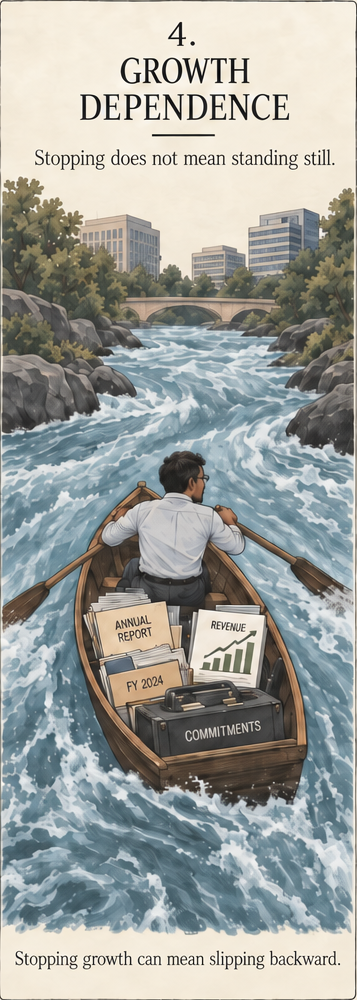
Maintaining demand can then become a condition of institutional stability. Slowing or stopping growth can carry material penalties: an institution does not need to “want” more in order to depend on producing more revenue.
Present corporate and governmental financial commitments are often organised around expectations of future income: insufficient growth can have serious adverse consequences that institutions are structured to avoid. Within this economic order, then, growth can become a condition of institutional survivalLorenz Keyßer, Julia K. Steinberger & Matthias Schmelzer — “Economic growth dependencies and imperatives: A review of key theories and their conflicts” (2025)Keyßer, Steinberger and Schmelzer identify many distinct mechanisms through which low or absent growth may create difficulties within existing institutional arrangements, while emphasising disagreement and major empirical gaps. The sentence is Wild School synthesis; the review does not establish one universal growth imperative.In conversation with ↓: Lorenz Keyßer, Julia K. Steinberger & Matthias Schmelzer Source ↗.
The intersecting and mutually reinforcing forces described here, operating across individual, social, material and institutionalBeniamino Cislaghi & Lori Heise — “Using social norms theory for health promotion in low-income countries” (2019)Cislaghi and Heise organise influences on behaviour across interacting individual, social, material and institutional domains. Unit III borrows the four-domain architecture; the wider manufacture of not-enoughness loop is Wild School synthesis, not a claim made by the article.In conversation with ↓: Beniamino Cislaghi & Lori Heise Source ↗ · Source ↗ life, together manufacture a system of not-enoughness. There is no grand scheme, no puppeteer behind the scenes: no conspiracy is required for these forces to form a patterned social order. But the absence of a manufacturer does not mean the absence of manufacture. Nor does it mean that nobody benefits from it: people and institutions with power can act to preserve arrangements that work to their advantage.
The Wild School wants to experiment with altering some of the conditions that can magnify not-enoughness: pace, purchasing opportunities, shared work, visible maintenance, contact with land, solitude, study, relationship, and wintering periodsAbraham Joshua Heschel — The Sabbath: Its Meaning for Modern Man (1951)Heschel presents Sabbath as sanctified time within Jewish religious life: a cessation from ordinary work, commerce and acquisitiveness rather than a technique for restoring productivity. Wintering periods is Wild School language inspired by this different relation to time and labour, not Heschel's term.In conversation with ↓: Abraham Joshua Heschel Source ↗ can all become part of the inquiry. Nobody knows what we ought to want less of, which ambitions we should renounce, or what enoughness should mean. We intend to change some of the conditions in which desire is experienced and ask what becomes desirable, necessary or sufficient there.
In conversation with
Material sufficiency / thresholds
Amartya Sen — capability / substantive freedomReadClose
Sen, Amartya. Development as Freedom. New York: Alfred A. Knopf, 1999. Source ↗
Sen argues that development should be assessed through the expansion of people’s substantive freedoms: their real opportunities to live in ways they have reason to value. Income and commodities matter as means, but the same resources can translate into very different actual capabilities depending on personal, social and institutional conditions. He therefore treats political freedoms, economic facilities, social opportunities, transparency guarantees and protective security as interconnected conditions that can enlarge or constrain what people are genuinely able to do and be.
Damaris Castro & Brent Bleys — subjective income sufficiencyReadClose
Castro, Damaris & Brent Bleys. “Do people think they have enough? A subjective income sufficiency assessment.” Ecological Economics 205 (2023): 107718. DOI: 10.1016/j.ecolecon.2022.107718 ↗
Castro and Bleys distinguish between the income level respondents say would be sufficient and their evaluation of whether their present income is sufficient. In survey data from Flanders, higher income is associated with both a greater likelihood of judging current income sufficient and a higher income level named as “enough.” They also find that fully paid homeownership is associated with greater perceived sufficiency without raising the quoted income threshold, while materialistic orientation is associated with a higher sufficiency threshold and a lower evaluation of current sufficiency.
Caspar Kaiser — income adaptation: adversarial evidenceReadClose
Kaiser, Caspar. “People do not adapt. New analyses of the dynamic effects of own and reference income on life satisfaction.” Journal of Economic Behavior & Organization 177 (2020): 494–513. DOI: 10.1016/j.jebo.2020.06.003 ↗
Kaiser re-examines claims that people adapt to changes in their own or reference income using long-running German and British panel data and dynamic models designed to separate persistent from temporary effects. His preferred analyses find no evidence that the life-satisfaction effect of own income fades back toward baseline over time, and no corresponding adaptation to reference income. The paper therefore challenges a simple income “hedonic treadmill” account in which the subjective benefits of increased income reliably disappear through adaptation.
Paul G. Bain & Renata Bongiorno — finite stated wealth idealsReadClose
Bain, Paul G. & Renata Bongiorno. “Evidence from 33 countries challenges the assumption of unlimited wants.” Nature Sustainability 5 (2022): 669–673. DOI: 10.1038/s41893-022-00902-y ↗
Bain and Bongiorno asked participants in 42 community samples across 33 countries how much money they would want if they could choose wealth for an absolutely ideal life. Most participants selected a finite amount rather than the effectively unlimited option, although preferred amounts varied substantially across people and settings. The study therefore challenges the assumption that unlimited material wants are a universal stated preference. It is a hypothetical choice study conducted from respondents’ existing circumstances and does not test how preferred wealth changes after people actually become wealthier.
Structural insecurity / self-insurance
Severin Rapp & Stefan Humer — public and private safety netsReadClose
Rapp, Severin & Stefan Humer. “Wealth and Welfare: Do Private and Public Safety Nets Compensate for Asset Poverty?” Social Inclusion 11(1) (2023): 176–186. DOI: 10.17645/si.v11i1.5937 ↗
Rapp and Humer examine households’ ability to withstand the loss of labour income across 18 OECD economies by combining household wealth data with country-specific social-benefit rules and family support. Their augmented measure of financial vulnerability shows that the protection offered by a given stock of private assets depends substantially on unemployment, minimum-income, housing and family benefits available after income loss. In the European countries studied, including welfare-state and family buffers substantially reduces measured asset vulnerability compared with an assets-only measure.
Shin-Yi Chou, Jin-Tan Liu & James K. Hammitt — health insurance and precautionary savingReadClose
Chou, Shin-Yi, Jin-Tan Liu & James K. Hammitt. “National Health Insurance and precautionary saving: evidence from Taiwan.” Journal of Public Economics 87(9–10) (2003): 1873–1894. DOI: 10.1016/S0047-2727(01)00205-5 ↗
Chou, Liu and Hammitt use Taiwan’s 1995 introduction of universal National Health Insurance as a natural experiment to examine whether health expenditure risk affects household saving. Comparing households with different levels of insurance before the reform, they find that expanding comprehensive health coverage reduced saving and increased consumption, with stronger saving effects among households that had been more exposed to medical-expense risk. The study interprets this pattern as evidence that public health insurance can substitute for part of the precautionary saving households otherwise use to self-insure against uncertain medical costs.
Andrew Benito — job insecurity and precautionary behaviourReadClose
Benito uses British Household Panel Survey data to examine whether anticipated unemployment risk affects household consumption. He compares workers’ own reported probability of becoming unemployed with a model-predicted unemployment risk based on observed characteristics and employment history. Higher insecurity is associated with lower current consumption and delayed durable-goods purchases, consistent with precautionary behaviour, while subjective and model-predicted risks overlap without being identical. The analysis therefore treats perceived job insecurity as economically consequential without assuming that it is a perfect measure of objective exposure.
Care / relational provision
Shahra Razavi — care diamond / distribution of careReadClose
Razavi, Shahra. “The Political and Social Economy of Care in a Development Context: Conceptual Issues, Research Questions and Policy Options.” UNRISD Gender and Development Programme Paper No. 3. Geneva: UNRISD, 2007. Source ↗
Razavi analyses care as work distributed among different institutional sites rather than as an activity naturally belonging to families or markets. Her “care diamond” distinguishes household/family, state, market and community or not-for-profit provision and shows that the boundaries among them vary historically and politically. The paper also emphasises that unpaid care has real labour, time and distributional costs, is strongly gendered, and can subsidise both markets and public systems when those costs remain invisible in conventional economic accounts.
Eric Bonsang — informal and formal elder careReadClose
Bonsang, Eric. “Does informal care from children to their elderly parents substitute for formal care in Europe?” Journal of Health Economics 28(1) (2009): 143–154. DOI: 10.1016/j.jhealeco.2008.09.002 ↗
Using data on older adults with children in nine European countries, Bonsang examines whether help from adult children substitutes for formal care. Informal care is found to substitute for paid domestic help particularly among people with lower levels of disability, while the substitution becomes weaker as disability rises; informal care is instead weakly complementary to nursing care. The study therefore shows that informal and formal provision can sometimes substitute for one another, but that this depends on the type and intensity of care needed.
Atul Gawande — intergenerational care and independenceReadClose
Gawande, Atul. Being Mortal: Medicine and What Matters in the End. New York: Metropolitan Books / Henry Holt, 2014. Source ↗
In the opening chapter of Being Mortal, Gawande contrasts multigenerational arrangements in which older people remain within extended family households with modern arrangements organised increasingly around individual independence, medical systems and formal elder care. Through his grandfather’s life in India and later examples, he notes that family arrangements can reduce the need to purchase services such as residential care or meal assistance, while also showing that such arrangements depend on younger relatives remaining available and accepting substantial obligations. The chapter therefore treats changing elder-care institutions as both a gain in individual independence and a redistribution of dependency and care work.
Social / mimetic threshold
René Girard — mimetic desireReadClose
Girard, René. Deceit, Desire, and the Novel: Self and Other in Literary Structure. Trans. Yvonne Freccero. Baltimore: Johns Hopkins Press, 1965. Source ↗
Girard develops the idea of “triangular” or mediated desire through readings of Cervantes, Stendhal, Flaubert, Proust and Dostoevsky. Rather than describing desire as a simple relation between a self-contained subject and an intrinsically desirable object, he argues that another person can function as a model or mediator whose own apparent valuation helps make the object desirable. The book distinguishes different forms of mediation and explores rivalry, imitation and self-deception as consequences of this structure of desire.
Alois Stutzer — income aspirationsReadClose
Stutzer, Alois. “The Role of Income Aspirations in Individual Happiness.” Journal of Economic Behavior & Organization 54(1) (2004): 89–109. DOI: 10.1016/j.jebo.2003.04.003 ↗
Stutzer examines whether subjective wellbeing depends not only on income itself but on income relative to people’s aspirations. Using Swiss survey data, he finds that higher income aspirations are associated with lower life satisfaction at a given income, while aspiration measures rise with respondents’ own income and with average income in their community. Supplementary panel evidence also indicates that earlier household income predicts later estimates of the minimum income a household needs.
Hovi, Matti & Jani-Petri Laamanen. “Income, aspirations and subjective well-being: International evidence.” Journal of Economic Behavior & Organization 185 (2021): 287–302. DOI: 10.1016/j.jebo.2021.02.030 ↗
Hovi and Laamanen use international microdata to examine how income aspirations relate to subjective wellbeing and how those aspirations adjust to economic circumstances. Higher aspirations are associated with lower subjective wellbeing, and aspiration adjustment offsets part of the wellbeing gain associated with higher income, particularly in richer countries. Their panel analyses also find that aspirations respond to changes in both people’s own incomes and the incomes of others.
Early Buddhist texts / desire and craving
Early Buddhist tradition — Raṭṭhapāla Sutta (MN 82): craving and non-satiationReadClose
The Raṭṭhapāla Sutta presents craving as a condition not reliably brought to rest by acquisition. Raṭṭhapāla tells King Koravya that the world is unstable, without shelter or ownership, and “insatiable” or “not enough,” enslaved by craving. In their dialogue the king says that, after gaining prosperous lands in every direction, he would also seek territory beyond the ocean; the discourse uses this image to portray sensual wanting as capable of extending beyond each acquisition rather than reaching a final point of satisfaction.
Verses 186–187 of the Dhammapada state that sensual pleasures do not yield satiation even under an imagined shower of money or coins, contrasting their limited gratification with the ending of craving. Verses 334–338 portray craving as growing like a creeping vine, moving from one object to another like a monkey seeking fruit, and returning again when its underlying root remains. Together the passages present craving as a recurring form of thirst rather than as a need that is necessarily extinguished by obtaining a desired object.
Social-symbolic / compensatory desire
Nicole Mead et al. — exclusion and affiliation-oriented consumptionReadClose
Mead, Nicole L., Roy F. Baumeister, Tyler F. Stillman, Catherine D. Rawn & Kathleen D. Vohs. “Social Exclusion Causes People to Spend and Consume Strategically in the Service of Affiliation.” Journal of Consumer Research 37(5) (2011): 902–919. DOI: 10.1086/656667 ↗
Across four experiments, Mead and colleagues test how social exclusion affects consumption when goods or spending can communicate affiliation. Excluded participants change product choices, spending and consumption in ways expected to facilitate social reconnection, including choosing products associated with a desired group or matching another person’s consumption preferences. The effects depend on whether consumption is plausibly useful for renewed affiliation rather than showing a general tendency for excluded people simply to consume more.
Marsha Richins — wanting versus havingReadClose
Richins, Marsha L. “When Wanting Is Better than Having: Materialism, Transformation Expectations, and Product-Evoked Emotions in the Purchase Process.” Journal of Consumer Research 40(1) (2013): 1–18. DOI: 10.1086/669256 ↗
Richins examines emotions before and after acquisition among consumers differing in materialism. Across cross-sectional and longitudinal studies, highly materialistic consumers report stronger positive emotion while anticipating desired acquisitions and often expect products to transform their lives; those positive emotions decline after acquisition. Consumers lower in materialism do not show the same pattern to the same degree. The paper therefore describes a purchase-cycle dynamic associated specifically with materialistic orientation rather than a universal law of acquisition.
Marsha Richins — advertising and comparison standardsReadClose
Richins, Marsha L. “Social Comparison and the Idealized Images of Advertising.” Journal of Consumer Research 18(1) (1991): 71–83. DOI: 10.1086/209242 ↗
Richins investigates how idealised advertising images affect comparison standards and self-evaluation. In studies focused on physical attractiveness, exposure to idealised models changes the standards women use for comparison and can reduce satisfaction with their own attractiveness. The paper treats advertising as one source of comparison information capable of altering evaluation within a specific domain rather than as evidence that advertising resets every dimension of people’s aspirations.
Suzanna Opree et al. — advertising, product desire and materialism in childrenReadClose
Opree, Suzanna J., Moniek Buijzen, Eva A. van Reijmersdal & Patti M. Valkenburg. “Children’s Advertising Exposure, Advertised Product Desire, and Materialism: A Longitudinal Study.” Communication Research 41(5) (2014): 717–735. DOI: 10.1177/0093650213479129 ↗
Opree and colleagues follow 466 Dutch children aged eight to eleven across two survey waves separated by twelve months. Greater television-advertising exposure predicts stronger subsequent desire for advertised products, and advertised-product desire mediates the longitudinal association between exposure and later materialism. The study is population-specific and observational rather than a general test of advertising effects among adults.
Barton, Belinda, Natalina Zlatevska & Harmen Oppewal. “Scarcity tactics in marketing: A meta-analysis of product scarcity effects on consumer purchase intentions.” Journal of Retailing 98(4) (2022): 741–758. DOI: 10.1016/j.jretai.2022.06.003 ↗
Barton, Zlatevska and Oppewal meta-analyse 416 effect sizes from 131 studies on product-scarcity cues. Across the literature, scarcity cues generally increase product desirability and purchase intentions, but effects vary with how scarcity is created and with product characteristics. The review therefore supports scarcity as a marketing tactic capable of amplifying perceived value and purchase motivation while also documenting important contextual moderators.
Marian Friestad & Peter Wright — persuasion knowledgeReadClose
Friestad, Marian & Peter Wright. “The Persuasion Knowledge Model: How People Cope with Persuasion Attempts.” Journal of Consumer Research 21(1) (1994): 1–31. DOI: 10.1086/209380 ↗
Friestad and Wright propose that people develop knowledge about persuasion agents, tactics and goals through experience and use that knowledge when interpreting and responding to advertising and selling attempts. Their model treats persuasion as an interaction between marketers’ attempts and consumers’ evolving coping knowledge rather than as information transmitted into passive recipients. Persuasion knowledge can change how a tactic is interpreted without implying that recognising persuasion makes a person immune to it.
Institutional growth dependence
Lorenz Keyßer, Julia K. Steinberger & Matthias Schmelzer — growth dependenceReadClose
Keyßer, Lorenz, Julia K. Steinberger & Matthias Schmelzer. “Economic growth dependencies and imperatives: A review of key theories and their conflicts.” Ecological Economics 238 (2025): 108745. DOI: 10.1016/j.ecolecon.2025.108745 ↗
Keyßer, Steinberger and Schmelzer systematically review 248 publications on proposed economic growth dependencies and growth imperatives. They identify 112 mechanisms grouped into 21 clusters and six broad themes through which low or absent growth may create adverse consequences within existing institutional arrangements. The review also documents substantial disagreement about the role of market competition, private property, monetary systems and the state, and emphasises major gaps in empirical testing; it does not identify one universal mechanism requiring all institutions or economies to grow.
Manufacture / cross-level interaction
Beniamino Cislaghi & Lori Heise — interacting individual, social, material and institutional domainsReadClose
Cislaghi, Beniamino & Lori Heise. “Using social norms theory for health promotion in low-income countries.” Health Promotion International 34(3) (2019): 616–623. DOI: 10.1093/heapro/day017 ↗ · Open text ↗
Cislaghi and Heise present a dynamic framework in which behaviour and social-norm effects are shaped through interaction among four domains: individual, social, material and institutional. The framework is designed to resist explanations that isolate norms from the wider conditions in which behaviour becomes possible, rewarded or constrained. Chapter III’s wider “manufacture of not-enoughness” synthesis is the Wild School’s own extension rather than a claim made by this article.
Enough as inquiry / protected cessation
Abraham Joshua Heschel — Sabbath / sanctified timeReadClose
Heschel, Abraham Joshua. The Sabbath: Its Meaning for Modern Man. New York: Farrar, Straus and Young, 1951. Source ↗
Heschel presents the Sabbath within Jewish religious life as sanctified time rather than simply a pause undertaken to restore productivity. In the opening movement of the book he contrasts civilisation’s concern with things in space with the holiness of time and describes Sabbath observance as cessation from ordinary work, commerce and acquisitiveness. The argument is theological and covenantal: the Sabbath is a “palace in time” in which human life enters a different relation to labour, possession and sacred time.