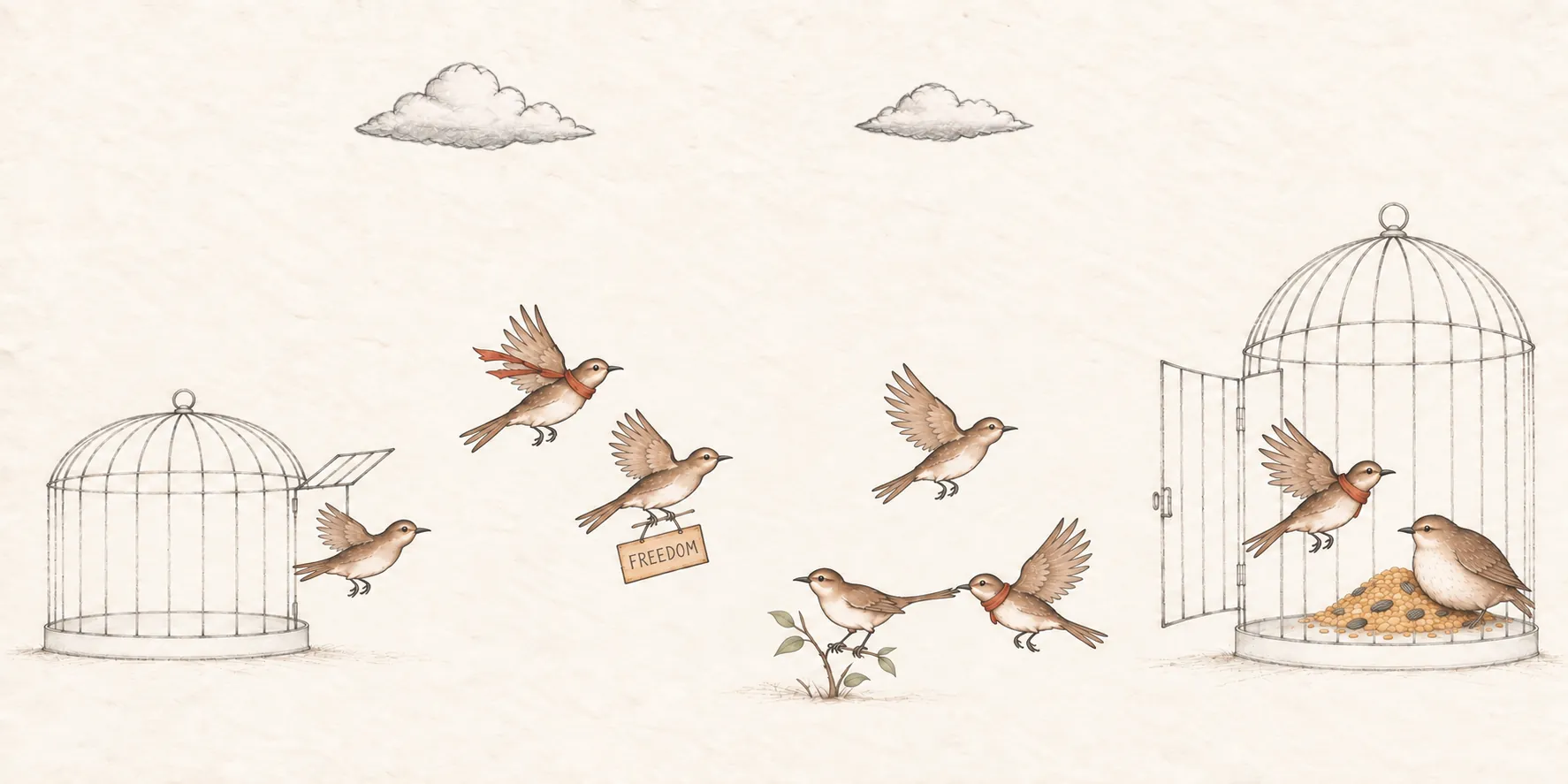
As the master's houseAudre Lorde — “The Master’s Tools Will Never Dismantle the Master’s House”Audre Lorde’s “The Master’s Tools Will Never Dismantle the Master’s House” asks whether liberatory work can produce fundamental change while reproducing exclusions and relations inherited from the order it opposes. The “master’s house” enters Unit V from this argument about difference, power and inherited forms of domination.In conversation with: Audre Lorde
Source ↗ enters the horizon of our awareness, it can no longer fully disappear from view. Many of us respond with a rightful desire to create more just conditions for those oppressed by its walls, but learning to recognise oppressive structures does not place us outside them. Without deep self-reflexivity, corrective action risks acquiring the virtuosity of knowing without being: becoming fluent in the language of domination while continuing to carry affective habits and relational patterns formed within it.
As activists for social justice, our identities and ways of experiencing the world remain deeply rooted in histories and relations that we consciously oppose, so that we carry ways of understanding ourselves, exercising authority, seeking recognition and responding to difference that sociopolitical analysis alone does not erase. Awareness is not innocenceAnthony Giddens — The Constitution of SocietyAnthony Giddens provides one floorboard for this claim: people can be knowledgeable and reflexive about what they do while still reproducing social relations whose conditions and consequences they only partly understand. Recognition therefore does not automatically place action outside the structures it contests.In conversation with: Anthony Giddens
Source ↗: learning to recognise domination does not make us immune from reproducing some of the oppressive relations through which it operates.
The tantalising promise of locating oppression entirely in an oppressive other can return as a barbed-wire wall in our own journey towards social justice. If the relations from which we want to liberate ourselves and others can also be reproduced through the ways we struggle against them, then the path itself becomes politically consequential. Wild School synthesisThis is a Wild School synthesis rather than a borrowed formula. Freire’s distinction between dialogical and antidialogical action, Lorde’s “master’s tools,” and Combahee’s practice of criticism and self-criticism all resist the idea that a liberatory end settles the political character of the means used to pursue it.In conversation with: Paulo Freire · Audre Lorde · Combahee River Collective
Source ↗ · Source ↗ · Source ↗: the justice of our goal does not make the process through which we pursue it politically or emotionally neutral. How we speak about and confront oppressive systems, how we essentialise those who benefit from extractive relations, how we distribute power, how we interpret and attribute value to others' desires and actions, and, more generally, how we treat people along the way are among the sharpest edges of activist work that seeks to be liberatory.
Intuitively, a form of activism starts to demand attention: what we call Wild School termActivism intentionally oriented toward liberation from oppressive systems while treating the form of action itself as politically consequential.. As a new category, liberation activism needs both a compass and guardrails. We suggest that intention is its cornerstone: without a genuine commitment to liberation from an oppressive system, for both us and others, there can be no liberatory practice. But, as we discussed, good intentions do not make liberation activists innocent of reproducing domination: a just cause does not ensure just action. A liberatory end must begin to take form in the relation action creates in the present.
Intentional liberation praxis can be poisoned by corruptive personal and social dynamics. The first of these poisons is Wild School synthesisThis three-direction frame is a Wild School synthesis. Combahee supplies the inward problem of contradiction within liberatory movements; Mohanty the outward production of an already-known oppressed subject; Bronfenbrenner the adversarial “mirror image.” Cornwall is a supporting guardrail against making dominant groups analytically homogeneous.In conversation with: Combahee River Collective · Chandra Talpade Mohanty · Urie Bronfenbrenner · Andrea Cornwall
Source ↗ · Source ↗ · Source ↗ · Source ↗ · Open text ↗: reducing people to the position we assign them in a system of oppression. Essentialisation can work in every direction: inwards, outwards, and across.
First, activists can create inner stories of liberators beyond contradiction. But people do not cease to engender contradictory thoughts and actions because they are in a seemingly just movement. The Combahee River Collective emerged from the recognition that Black women could struggle alongside Black men against racism while confronting sexism within their movement, just as they encountered racism within women’s liberation movements.
Second, essentialisation can look outwards, towards those who are disadvantaged in a particular relation of power—which might include the observers themselves. Under an essentialist gaze, they are allowed to be nothing but the oppressed: their experience of domination becomes sufficient knowledge of who they are, what they need, or what liberation should mean to them. Chandra Mohanty famously showed how some Western feminist scholarship produced “Third World women” as a single, already-known category of victims while implicitly positioning Western women as the knowing, liberated subject.
Finally, essentialisation can look across. Real or, crucially, imagined opponents of our cause can be seen as oppressors without remainder, as though the position we assign them—legitimately or not—exhausted who they are or foreclosed the possibility of transformation. During the Cold War, research on American and Soviet perceptions found a striking mirror image: each side understood the other as fundamentally aggressive while imagining itself as essentially peaceful and defensive.
Granted, Chandra Talpade Mohanty — “Under Western Eyes: Feminist Scholarship and Colonial Discourses” · Andrea Cornwall — “Missing Men? Reflections on Men, Masculinities and Gender in GAD”The caution here is not that categories such as oppressor and oppressed are false or symmetrical. Mohanty and Cornwall show a narrower danger: categories that identify real relations of power can begin doing too much explanatory work when they become sufficient knowledge of the people placed inside them.In conversation with: Chandra Talpade Mohanty · Andrea Cornwall
Source ↗ · Source ↗ · Open text ↗ for unequal relations of power; they are not equivalent positions, nor are they complete identities of the people who occupy them. A relation of power is never sufficient knowledge of a person—their motives, character, or capacity to act otherwise. This matters because essentialisation does not merely simplify who another person is; it begins to interpret their actions before we encounter them. Once a category becomes sufficient knowledge of the other, it begins to whisper interpretations of their actions, and the possibility of a real encounter closes before it has begun.
The second poison is Paulo Freire — Pedagogy of the Oppressed · Beniamino Cislaghi — Human Rights and Community-Led Development · Beniamino Cislaghi, Diane Gillespie & Gerry Mackie — Values Deliberation and Collective ActionFreire’s dialogical politics is the principal floorboard: liberation turns antidialogical when people become objects of somebody else’s programme rather than subjects capable of changing it. Cislaghi’s work on community-led development supplies a related practical question: can outside action expand another person’s agency without taking ownership of their destination?In conversation with: Paulo Freire · Beniamino Cislaghi · Beniamino Cislaghi, Diane Gillespie & Gerry Mackie
Source ↗ · Source ↗ · Source ↗: we become Alagaddūpama Sutta — Majjhima Nikāya 22 · Nāgārjuna — Mūlamadhyamakakārikā XIII.8Two deliberately bounded philosophical analogies sit beneath this sentence. The Buddhist raft simile warns against clinging even to a vehicle intended for liberation; Nāgārjuna warns that a concept used to loosen fixed views can itself become another fixed view. Neither source is being presented as a political theory.In conversation with: Alagaddūpama Sutta · Nāgārjuna
Source ↗ · Source ↗ that we feel entitled to know for the other, anticipate or judge their intentions and actions, and eventually decide on their behalf. The other's disagreement with our project is ignorance, their refusal a failure of their consciousness. Substitutive praxis becomes a cage in which the subjecthood of the other comes to die: it polices what others are permitted to intend, desire, say and do. It sacrifices the agency of the other—their capacity to surprise us, refuse us, and transform our praxis—in order to protect us from having to slow our action, question our position, or confront the possibility of our own arrogance, ignorance, or failure.
Paulo Freire — Pedagogy of the OppressedThe continuing relation between reflection and action through which liberation is pursued, tested and revised in encounter with others and with the consequences of action.In conversation with: Paulo Freire
Source ↗ must remain committed to reflexive inquiry and correction. The other's disagreement, refusal or surprise, if welcomed, can offer new openings in liberatory praxis: mirrors reflecting back what our action has become. In the encounter with the other, liberatory praxis preserves the transformative possibility of the whole relational field. Wild School synthesisA Wild School term for the inner commitment to remain correctable: to resist categorical closure, notice substitution and allow encounters or consequences to change one’s understanding and direction. Giddens and Freire are important floorboards, but the three-part corrigibility framework itself is ours.In conversation with: Anthony Giddens · Paulo Freire
Source ↗ · Source ↗ is the conscious inner commitment to refuse essentialisation, be alert to substitution, and be committed to the possibility of changes of direction in our practice.
Paulo Freire — Pedagogy of the Oppressed · Combahee River Collective — “The Combahee River Collective Statement”A Wild School term for the capacity to change position when correction threatens identity, loyalty, belonging or status. Freire’s contrast between radical openness and sectarian certainty, together with Combahee’s practice of criticism and self-criticism within political commitment, helps ground the distinction.In conversation with: Paulo Freire · Combahee River Collective
Source ↗ · Source ↗ is the capacity to change our position when correction threatens our identity and possibly our membership in a professional, activist, or other community. The same relations that give collective action courage and solidarity can also make correction costly: criticism may feel like betrayal, loss of belonging or status, or a fracture in our moral identity.
Anthony Giddens — The Constitution of Society · Scott Alexander — “Meditations on Moloch”A Wild School term for the practical room to act on correction. People and organisations may recognise a problem yet remain constrained by income, funding, institutional survival or other dependencies. The point is to avoid reducing an inability to change to personal defensiveness alone.In conversation with: Anthony Giddens · Scott Alexander
Source ↗ · Source ↗ is the practical room to change. Recognising that our praxis needs correction does not mean that we feel able to correct it. We may know that a programme is doing little good while depending on it for our salary. Or an organisation may recognise that a funder's priorities are distorting its work while knowing that refusing them could cost colleagues their jobs or threaten the organisation's survival. Because it manufactures not-enoughness, the system in which liberatory praxis unfolds can itself encage that praxis, pushing correction outside of the horizon of what is possible. Alternatives may be dismissed as naïve when the costs of attempting them feel unbearable, or when meaningful change would require such a profound reorganisation of the surrounding system that complicity comes to seem like the most viable condition of survival within it.
Material constraints at times do not offer any Bhagavad Gītā — 2.47; 3.4; 3.19 · Max Weber — “Politics as a Vocation” · Michael Walzer — “Political Action: The Problem of Dirty Hands”Three different traditions meet beneath this claim. The Bhagavad Gītā refuses the idea that withdrawal automatically escapes responsibility; Weber asks political actors to answer for reasonably foreseeable consequences; Walzer argues that necessity does not make morally compromised action retrospectively clean. Together they resist both purity through refusal and absolution through good intentions.In conversation with: Bhagavad Gītā · Max Weber · Michael Walzer
Source ↗ · Source ↗ · Source ↗. Every available path may carry loss, complicity, or harm: a choice might be between losing the cause or “compromising with MolochScott Alexander — “Meditations on Moloch”Moloch is a metaphor for a system that people know is causing harm but still feel forced to participate in because opting out would cost them too much. Scott Alexander uses the image in Meditations on Moloch to describe situations where individually sensible choices keep producing a collectively damaging result.In conversation with: Scott Alexander
Source ↗.” In liberatory praxis, the absence of an ethically clean choice does not absolve responsibility; it changes what responsibility asks of us. We may have to choose among compromised options, but we remain answerable for how we choose, for the harms we can foresee, for the compromises we accept, and for how we commit to change the conditions that made compromises necessary.
Activist work aiming to rebalance power relations inevitably develops its own Anthony Giddens — The Constitution of Society · Jo Freeman — “The Tyranny of Structurelessness”Giddens describes social practices as recursively reproduced through repeated action; Freeman shows the organisational counterpart: refusing formal structure does not make power disappear, because informal networks, information and influence still organise collective life. Repetition can therefore harden action into arrangements that have political effects of their own.In conversation with: Anthony Giddens · Jo Freeman
Source ↗ · Source ↗: ways of deciding, distributing work, allocating resources and authorising action. As these practices are repeated, shared and institutionalised, they become arrangements of power in their own right, while remaining embedded in the larger political, financial and social relations they seek to transform. A civil society organisation, an NGO or an activist movement still depends on resources, institutions and relationships that condition its possibilities and, sometimes, its survival. The question at the core of liberation activism, then, is not only who gains power as a result of it, but what happens to the coercive, extractive and violent relations through which power operates in the system. Wild School synthesisThis is the organising synthesis of two different examples, not a quotation from either source. Razavi shows how care obligations can move between households, markets, the public sector and communities; Fanon shows how political independence can leave inherited economic channels and extractive relations substantially intact.In conversation with: Shahra Razavi · Frantz Fanon
Source ↗ · Source ↗
As one population gains greater access to power and resources, those gains can occur without changing the extractive relations of the wider system; exploitation and vulnerability may instead be displaced onto others. Women’s increased participation in paid employment, for example, has for many been a real expansion of freedom and economic power; yet the care work they had been expected to provide did not disappearShahra Razavi — “The Political and Social Economy of Care in a Development Context”Shahra Razavi’s care-economy analysis treats care as work distributed among households, markets, the public sector and community provision. When responsibility moves from one sphere to another, the underlying need—and its labour and distributional costs—does not vanish.In conversation with: Shahra Razavi
Source ↗. Where care was not reorganised collectively, some of it shifted to paid care sectors or to other women, often in lower-paid or more precarious positions. Political decolonisation confronted a parallel danger. FanonFrantz Fanon — The Wretched of the Earth, “The Pitfalls of National Consciousness”In “The Pitfalls of National Consciousness,” Frantz Fanon argues that a national bourgeoisie in newly independent states can inherit colonial commercial advantages, economic channels and institutions rather than reorganising production and social relations. His argument is historically situated, not a universal law of decolonisation.In conversation with: Frantz Fanon
Source ↗ warned that authority could pass from colonial rulers to a national bourgeoisie while economic relations and institutions inherited from colonialism remained substantially intact. In both cases, liberation changed the distribution of power and resources without dislodging the relations of dependence and extraction that sustained them. Liberation activism therefore aims to transform the relations through which power is accumulated and exercised, a task that may sometimes require limiting or redistributing the power we ourselves gain in order to contribute to a wider rebalancing of power.
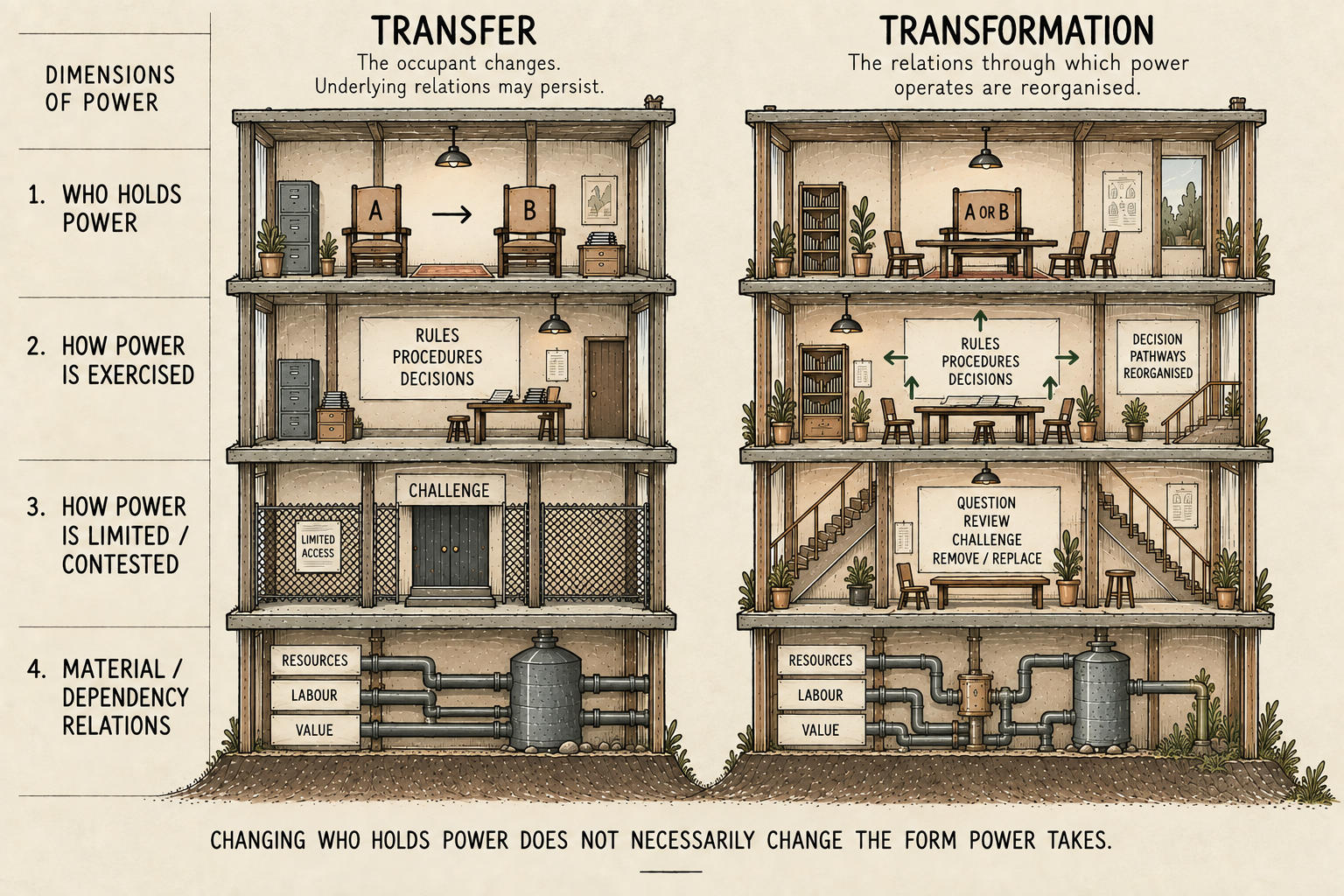
Wild School termChange in the relations through which power is accumulated, exercised, limited and contested, rather than only in who occupies positions of power. therefore asks what has changed in the relations themselves, rather than in the composition of the powerholders. A system changes in form when these relations are reorganised, rather than simply inherited by new actors. Liberation activism therefore attends to the real, lived conditions under which power can be exercised, limited, and contested. Because power cannot be trusted to be innocent, it must be answerable.
Jo Freeman — “The Tyranny of Structurelessness” · Ronald A. Heifetz — Leadership Without Easy AnswersJo Freeman and Ronald Heifetz support different sides of this formulation. Freeman argues for explicit, accountable and removable delegation rather than hidden informal power; Heifetz treats authority as a resource that can organise difficult collective work while remaining open to challenge. Neither argument justifies permanent or insulated authority.In conversation with: Jo Freeman · Ronald A. Heifetz
Source ↗ · Source ↗ Its capacity to work as intended also depends on the quality of the relations around power: people must be able to question and disagree without humiliation or punishmentAmy C. Edmondson — “Psychological Safety and Learning Behavior in Work Teams”Amy Edmondson uses “psychological safety” for conditions in which people can take interpersonal risks—asking questions, admitting errors, seeking feedback and raising disagreement—without those acts becoming humiliating or punitive threats. It means neither comfort nor immunity from accountability.In conversation with: Amy C. Edmondson
Source ↗ · Open text ↗, while those exercising authority must be able to acknowledge error and hold conflictRonald A. Heifetz — Leadership Without Easy AnswersRonald Heifetz argues that authority can help contain conflict and regulate pressure so difficult adaptive work remains possible, while protecting dissenting voices that may carry unwelcome information. “Holding” conflict here means keeping it workable, not suppressing disagreement or guaranteeing harmony.In conversation with: Ronald A. Heifetz
Source ↗ without armouring themselvesBrené Brown — “Armored Versus Daring Leadership,” Parts 1–2Brené Brown uses “armour” for self-protective leadership responses to uncertainty and vulnerability: needing to be right or to be the knower, avoiding difficult conversations, and using blame or shame defensively. This is a bounded relational metaphor here—not Unit V’s theory of power.In conversation with: Brené Brown
Source ↗ · Open text ↗ or treating challenge as a threat to their own position. Where those conditions fail, defensive routinesChris Argyris — “Action Science and Organizational Learning”Chris Argyris uses “defensive routines” for patterns through which people and organisations avoid embarrassment, threat or exposure while making difficult information harder to discuss and correct. The defence can therefore protect an institution from precisely the knowledge it needs in order to learn.In conversation with: Chris Argyris
Source ↗ can protect people and institutions from difficult knowledge at the cost of learning from it. Liberatory institutions therefore need authority that can act, challenge that can matter, and relationships capable of surviving correction.
The Wild School will inevitably create asymmetries of power through differences in roles, presence, ownership and expertise that cannot simply be wished away. The experiment with power is to explore meaningful ways for those affected by it to shape how that power is exercised, changed, redistributed or relinquished when it no longer serves the work at hand. Accountability serves liberation; it does not replace it. The question we wrestle with is to what extent this school for liberation can remain open and capable of being changed by the people and realities it encounters.