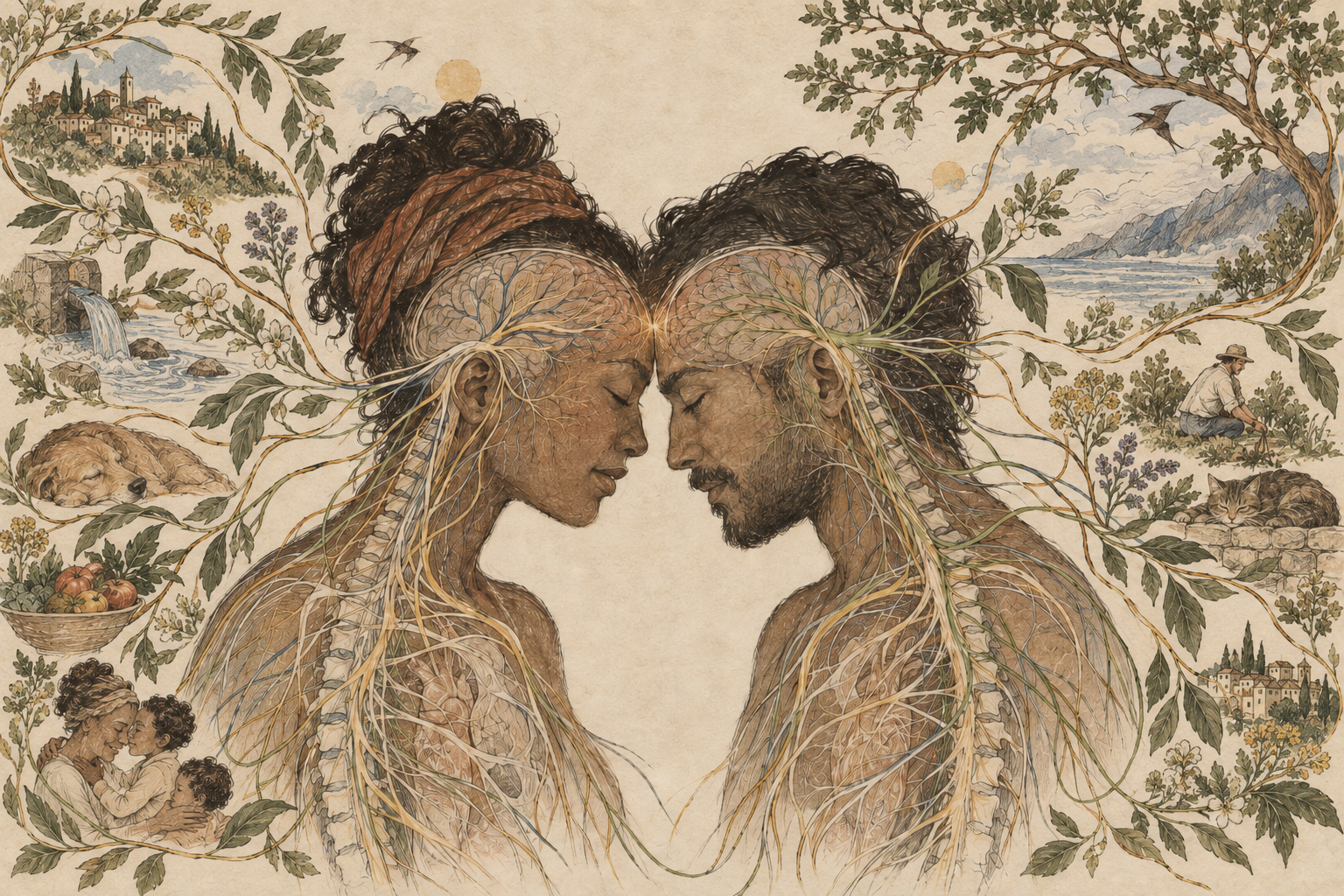
Suffering and wellbeing are, first of all, personally lived experiences. Each of us encounters pain, vitality, fear, ease, exhaustion, joy and meaning from within a life that remains irreducibly our own; being sustained through relations does not make us fragments of a collective, but whole personsIn conversation with Sins Invalid.Disability Justice brings Recognizing Wholeness together with Interdependence and Collective Access: people have inherent worth beyond productivity, depend on one another and may organise access around differing needs and capacities. The Wild School extends that conversation in its own account of personal experience.In conversation with ↓: Sins Invalid
Sins Invalid ↗ with distinct inner lives.
Yet wellbeing does not exist only as an individual condition: it is personal in experience, relational in the ways it is sustained or damaged, and collective in many of the conditions that make particular forms of life possibleSarah C. White · relational wellbeing.White distinguishes personal, relational and collective sites of wellbeing while treating them as dynamically interdependent rather than reducible to one another. Her framework directly shaped this distinction; the sentence itself is the Wild School’s formulation.In conversation with ↓: Sarah C. White
Sarah C. White ↗.
Our ability to sleep securely, eat well, heal, work without injury, or care and be cared for depends upon material circumstances, institutions and relations that are themselves socially and historically producedJaime Breilh — “The Social Determination of Health and the Transformation of Rights and Ethics” · WHO Commission on Social Determinants of Health — Closing the Gap in a GenerationSocial determination of health — Breilh treats health as historically produced through interacting social, political, material, biological and ecological processes. WHO likewise traces health to living conditions and distributions of power, money and resources.In conversation with: Jaime Breilh · WHO Commission on Social Determinants of Health
Source ↗ · Source ↗. Such arrangements also influence who encounters hazards at work, who lives with pollution, and who has access to protection; over time, these unequal conditions can become embodied as differences in health and illnessSocial production and ecosocial embodiment. Doyal and Pennell trace hazards produced through labour and political economy; Laurell examines how work and eating are simultaneously social and biological; Krieger develops a framework for investigating cumulative pathways of embodiment, resistance and accountability. The sentence is the Wild School's synthesis, not the wording of any one author.In conversation with ↓: Doyal and Pennell · Laurell · Krieger
Book record ↗ · Original Spanish text ↗ · Source ↗.
What is carried by one person can therefore emerge from, persist through, or be relieved by conditions extending far beyond that person.
The boundaries of experience are not the boundaries of causation: wellbeing is personal and not self-contained.
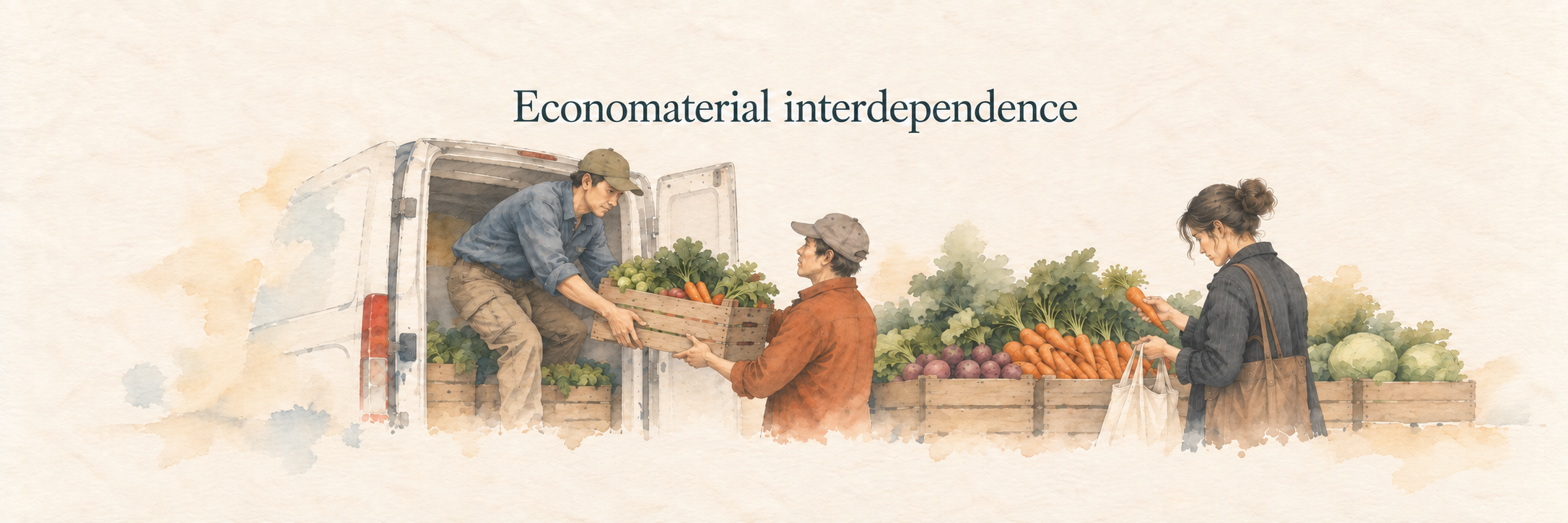
We propose five forms of interdependence. The first is economaterial interdependence: for us to eat, wash, heal, travel, stay warm and meet other material needs, we rely on chains of labour, provision, infrastructure, markets and institutions extending far beyond the individual. Paying for what we require does not abolish that dependence; it changes the relation through which the need is met. Nor must those relations be financial: the same need may be met through households, markets, public services, or communitiesShahra Razavi — “The Political and Social Economy of Care in a Development Context”Razavi's care diamond maps care across households/families, markets, the public sector and community or not-for-profit provision. Care needs can persist while responsibility for meeting them shifts between these sites.In conversation with: Shahra Razavi
Source ↗, with the burden of provision shifting between them. Because these conditions satisfy routine needs and must be continuously reproduced—food supplied, water treated, waste removed, bodies cared for, things cleaned and repaired—apparent autonomy rests upon forms of maintenanceMierle Laderman Ukeles — Manifesto for Maintenance Art 1969! Proposal for an Exhibition “CARE”Ukeles contrasts maintenance — repeated work that keeps, cleans, repairs, renews and sustains — with the cultural prestige attached to development, novelty and progress.In conversation with: Mierle Laderman Ukeles
Source ↗ that must continually be performed. Our economaterial dependencies can be organised so reliably, and often so anonymously, that they are mistaken for material self-sufficiency.
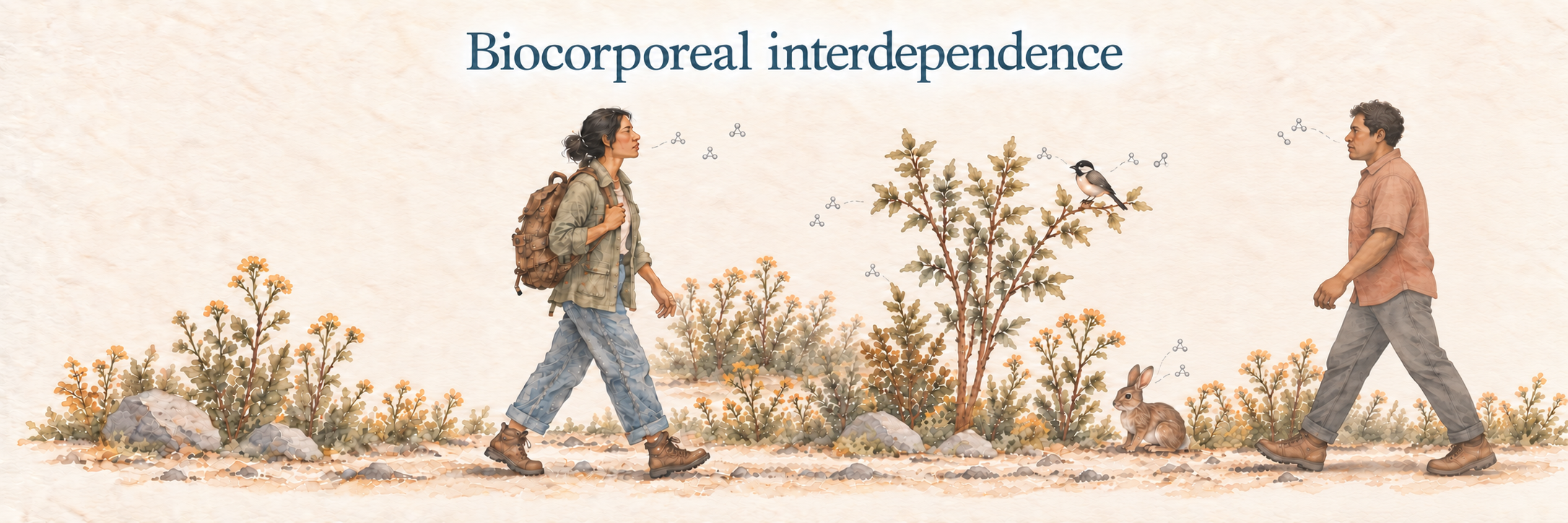
The second is biocorporeal interdependence. Living organisms are open systemsMary Ann Clark, Matthew Douglas & Jung Choi — Biology 2e, §6.3 “The Laws of Thermodynamics”Biological organisms are open systems: matter and energy cross the boundary between organism and surroundings while organised life is maintained.In conversation with: Mary Ann Clark, Matthew Douglas & Jung Choi
Source ↗, continuously exchanging matter and energy with their surroundings; with every breath, oxygen crosses the respiratory membrane into the blood while carbon dioxide moves outJ. Gordon Betts et al. — Anatomy and Physiology 2e, §22.4 “Gas Exchange”At the respiratory membrane, oxygen diffuses from alveolar air into pulmonary blood while carbon dioxide diffuses from blood into the alveoli.In conversation with: J. Gordon Betts et al.
Source ↗. Infection makes this openness less gently visible: biological material released by one body can enter another and alter its biological trajectoryWorld Health Organization — “Measles”WHO describes measles virus spreading through air and respiratory secretions released when an infected person breathes, coughs or sneezes — one concrete case of interbody biological exposure.In conversation with: World Health Organization
Source ↗. Within the body’s apparent boundaries, we are not biologically solitary either: humans live in persistent functional association with microbial symbiontsScott F. Gilbert, Jan Sapp & Alfred I. Tauber — “A Symbiotic View of Life: We Have Never Been Individuals”Gilbert, Sapp and Tauber argue that persistent microbial symbioses complicate simple accounts of biological individuality, including through roles in metabolism, development and immune function.In conversation with: Scott F. Gilbert, Jan Sapp & Alfred I. Tauber
Source ↗ that participate in metabolism, development, and immune function, complicating simple accounts of the biological individual.
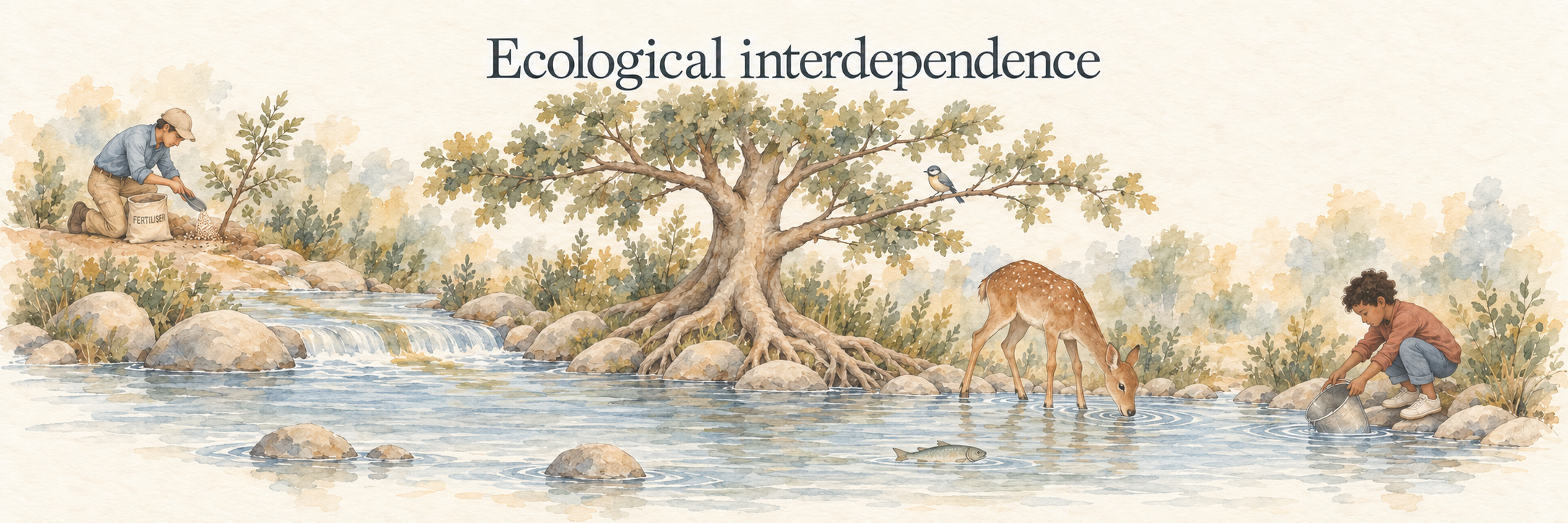
The third is ecological interdependence. Humans live within ecological systems that regulate climate, air quality, water quality, food production, and many other conditions of lifeSarah Whitmee et al. — “Safeguarding Human Health in the Anthropocene Epoch” · WHO & Secretariat of the Convention on Biological Diversity — Connecting Global PrioritiesPlanetary-health and biodiversity-health reviews document human health's dependence on functioning ecological systems, including climate, food, water and disease-regulating processes.In conversation with: Sarah Whitmee et al. · WHO & Secretariat of the Convention on Biological Diversity
Source ↗ · Source ↗. Human production, consumption, land use, and emissions alter the ecological systems upon which we depend. Those alterations can then return as new conditions of human health—through heat, polluted water, disrupted food systems, changing disease risksIPCC — Climate Change 2022: Impacts, Adaptation and Vulnerability, Summary for PolicymakersThe IPCC assesses multiple pathways from climate change to human health, including heat, food and water insecurity, infectious-disease risks and unequal vulnerability.In conversation with: IPCC
Source ↗, or other pathways. Nutrient pollution offers one concrete example: fertiliser, sewage, and runoff can contribute to harmful algal bloomsU.S. Centers for Disease Control and Prevention — “Harmful Algal Blooms: Contributing Factors and Impacts”CDC notes that excess nutrients from fertiliser, sewage and runoff can promote harmful blooms whose toxins can expose people through water or food.In conversation with: U.S. Centers for Disease Control and Prevention
Source ↗ whose toxins later enter human exposure through water and food. Ecological interdependence is recursive: we alter conditions that later return to alter us, though not necessarily equally or symmetrically.
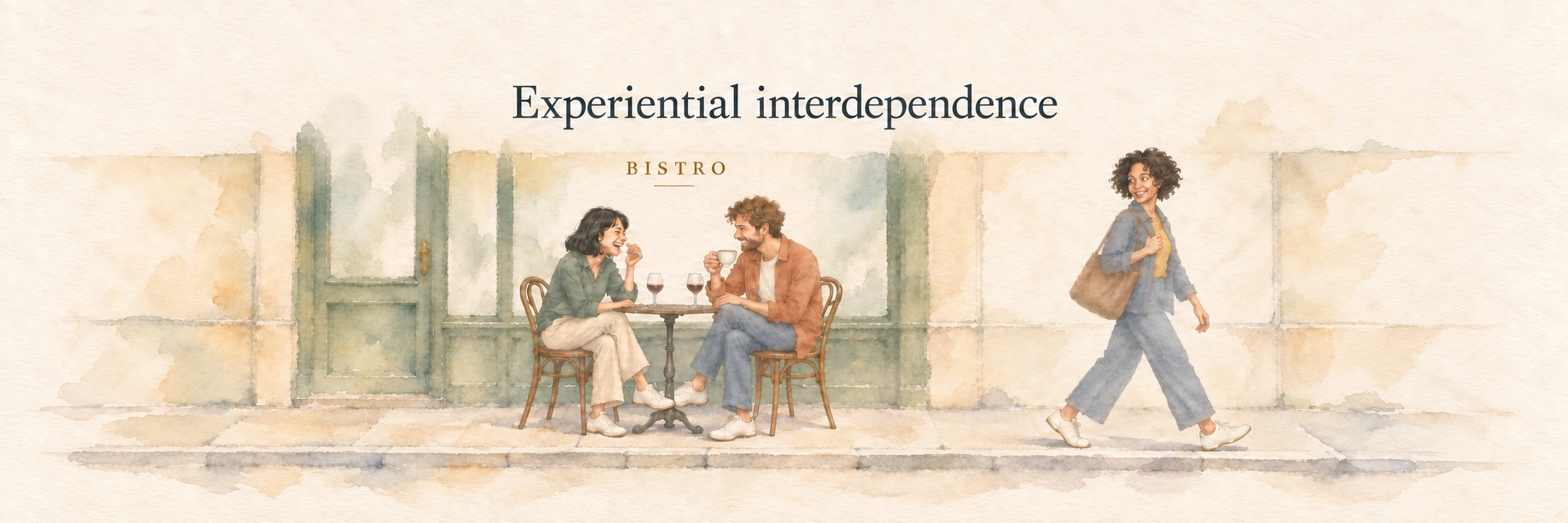
The fourth is experiential interdependence. We influence each other’s emotions within relationships and groups, and we hypothesise that such effects may propagate through wider chains of interaction beyond the immediate group. Affect transferSigal G. Barsade — “The Ripple Effect: Emotional Contagion and Its Influence on Group Behavior”Barsade experimentally varied a group member's affective display and found corresponding shifts in other members' observed and self-reported mood.In conversation with: Sigal G. Barsade
Source ↗, meaning the influence that affective displays such as facial expression, gaze, tone, speech pace, posture, and engagement can have on the mood of others, has been demonstrated experimentally. Social regulationJames A. Coan, Hillary S. Schaefer & Richard J. Davidson — “Lending a Hand”In a small fMRI threat experiment, hand-holding — especially by a spouse — attenuated subjective and neural threat responses.In conversation with: James A. Coan, Hillary S. Schaefer & Richard J. Davidson
Source ↗ has also been demonstrated experimentally: relations can alter how an event is experienced; supportive contact, for instance, can change subjective and neural responses to threat. Interaction can also become visible in autonomic physiology: heart rate, heart-rate variability, respiration, and skin conductance have all been found to become temporally coordinated between people in some contexts, although the forms and meanings of such physiological synchronyRichard V. Palumbo et al. — “Interpersonal Autonomic Physiology: A Systematic Review of the Literature”Palumbo and colleagues review studies in which autonomic measures such as heart rate, heart-rate variability, respiration, and skin conductance covary or become temporally coordinated between interacting people. The literature is heterogeneous; synchrony does not by itself identify a mechanism or imply identical subjective states.In conversation with: Richard V. Palumbo et al.
Source ↗ vary substantially across studies. Emotions therefore move across intra- and interpersonal processesArvid Kappas — “Social Regulation of Emotion: Messy Layers”Kappas treats emotion as recursively shaped across intra- and interpersonal levels and cautions that expression is not a transparent readout of felt emotion.In conversation with: Arvid Kappas
Source ↗, although what we feel, what we express, and how others interpret that expression are not identical. Emotional experiences are personal, but they are not experientially sealed. A person’s wellbeing can affect the emotional wellbeing of others, giving each of us a stake in forms of wellbeing that extend beyond ourselves. In this light, the famous Golden Rule, to treat others as we would wish to be treated, acquires an unexpected empirical resonance: the conditions we create for another person do not necessarily end with them.
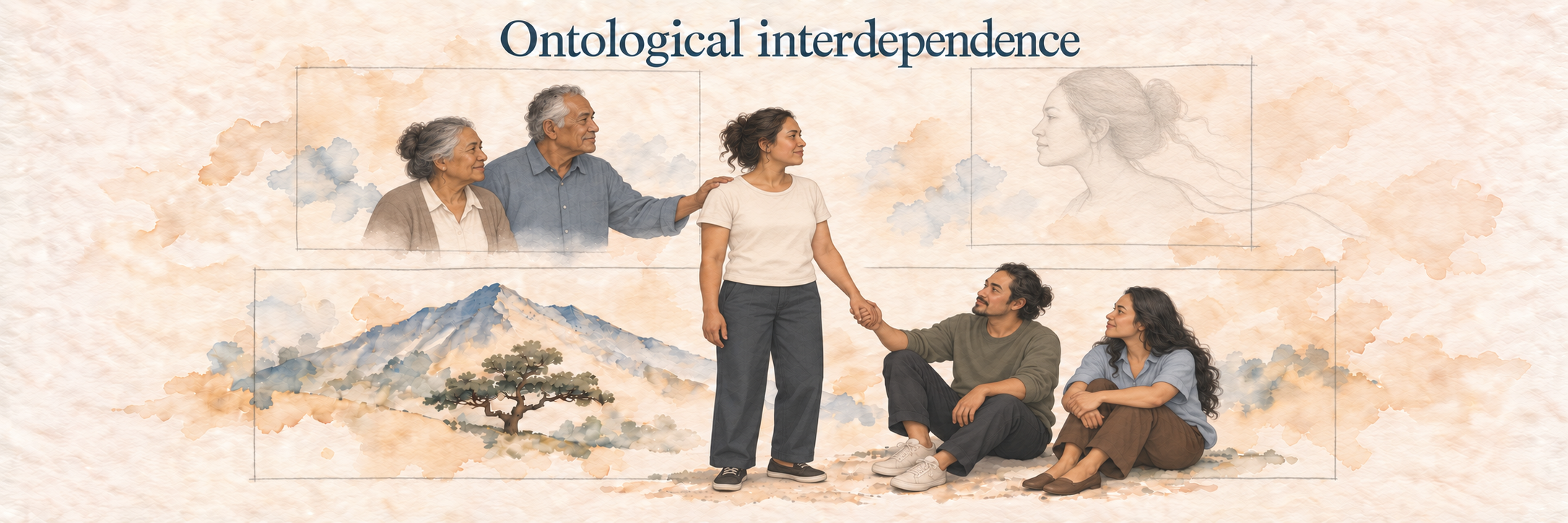
The fifth is ontological interdependence. This form of interdependence brings philosophical vertigo at the edge of the cognitive and the spiritual. Ontological interdependence questions the assumption that there is a universally shared understanding of what the self is and where its boundaries lie. Catherine Love, one of the School’s returning students, contrasts a Western image of the self as something like a self-contained vase, reflected in metaphors such as being “in pieces” or “putting myself back together,” with Māori accounts in which identity is located differently. In her work, pepeha can be a “statement of who I am by describing where I am from,”Catherine Maarie Amohia Love — Maori Voices in the Construction of Indigenous Models of Counselling Theory and PracticeIn Love's Māori counselling research, pepeha locates a speaker through whānau, hapū, iwi, marae, land, river and sea: identity is stated through where and from whom one comes.In conversation with: Catherine Maarie Amohia Love
Source ↗ while the Whanganui formulation Ko au te Awa, ko te Awa ko auTe Awa Tupua (Whanganui River Claims Settlement) Act 2017The Act records this Whanganui iwi pepeha — “I am the River and the River is me” — as expressing the intrinsic relationship between Whanganui iwi and the Whanganui River. It is Whanganui-specific, not a generic Māori doctrine.In conversation with: Te Awa Tupua (Whanganui River Claims Settlement) Act 2017
Source ↗, “I am the River and the River is me,” expresses the relation between river and people in explicitly identity-bearing terms. Other traditions travel in different directions. Some understand personhood as constituted through ancestry, community, territory, or relations with other beings; classical Yoga preserves a distinction between the “seer” and the “seen”Pātañjali — Yoga Sūtra 1.33 and 2.17, with classical commentaryYoga Sūtra 2.17 treats the conjunction of the seer and the seen as a cause of suffering. Classical Yoga here preserves their distinction rather than teaching cosmic merger.In conversation with: Pātañjali
Source ↗; early Buddhism questions the existence of any permanent selfAnattalakkhaṇa Sutta (SN 22.59) and Kaccānagotta Sutta (SN 12.15)SN 22.59 rejects identifying the five aggregates as a permanent self; SN 12.15 frames arising and cessation conditionally while rejecting the extremes of absolute existence and non-existence.In conversation with: Anattalakkhaṇa Sutta (SN 22.59) and Kaccānagotta Sutta (SN 12.15)
Source ↗ · Open text ↗; and some Upaniṣadic traditions radically relocate identity through formulations such as “I am Brahman.Bṛhadāraṇyaka Upaniṣad 1.4.10Bṛhadāraṇyaka Upaniṣad 1.4.10 contains aham brahmāsmi — “I am Brahman” — within an Upaniṣadic metaphysical and soteriological account of self and Brahman.In conversation with: Bṛhadāraṇyaka Upaniṣad 1.4.10
Source ↗”
If humans draw different boundaries around the “self,” then whatever we mean by self is not universal in form. It can instead be understood as an ensemble of cognitive, cultural, philosophical, and spiritual maps, rather than as something reducible to biological fact. The boundaries we draw around the wellbeing of the self therefore also require new maps.
If what we call a self is, depending on the ontology, a relation, a process, a temporary configuration, an expression of a wider whole, or not an ultimately existing entity at all, then wellbeing cannot automatically be assumed to reside within the individual (whatever independent status the individual retains) as its natural container.
Ontological interdependence therefore demands an epistemological revolution, because it changes the question of what the relevant unit of wellbeing is and, in its most radical forms, whether there is more than one unit at all. Parmenides pushed this problem to an extreme more than two millennia ago, describing What-Is as “all together, one, cohesive.Parmenides — Fragment B8In Fragment B8, Parmenides characterises What-Is as “all together, one, cohesive.” This is an Eleatic metaphysical claim about being, not a theory of wellbeing.In conversation with: Parmenides
Source ↗” Depending on the ontology, the whole may be more than the environment surrounding the self: it may partly constitute the self, be one with the self, or be ontologically prior to it. On such accounts, the health of the whole may therefore be irreducible to the health of its apparent parts.
Interdependence does not, by itself, carry a moral verdict. Depending on others and participating in collective life need not threaten freedom; people can organise common life without surrendering individual agencyElinor Ostrom — Governing the Commons (1990)Ostrom’s comparative cases show common-pool resource users building durable forms of self-governance through arrangements including participant rule-making, accountable monitoring, conflict resolution, and recognised rights to organise. She does not present these as a universal recipe.In conversation with: Elinor Ostrom
Source ↗. The danger begins when solidarity becomes enforced identification or homogeneityIris Marion Young — “City Life and Difference” (1990)Young criticises ideals of community based on fusion, mutual identification, and shared values when they suppress difference or exclude people who do not fit the collective identity.In conversation with: Iris Marion Young
Source ↗, or when belonging makes dissent, voice, and exit prohibitively costlyAlbert O. Hirschman — Exit, Voice, and Loyalty (1970)Hirschman distinguishes exit from voice and shows how loyalty and high penalties for exit can delay leaving and alter the possibility of speaking for change from within.In conversation with: Albert O. Hirschman
Source ↗. For the Wild School, the challenge is therefore to honour interdependence without allowing it to become coercion: to cultivate forms of belonging that deepen mutual reliance while protecting difference, refusal, exit, and self-expression.
The relevant learning for the Wild School is to honour our interdependence through experiences of shared living, without dissolving our individualities into communal belonging. The direction of travel for us becomes learning to inhabit the relations that sustain us more consciously, nourished both by the recognition of our interdependence and by the exciting self-affirmation we find in our similarities and differences.